

Short answer: an exact calibration gas concentration is never a single spec on a datasheet — it's the result of a verified chain: each Mass Flow Controller (MFC) is individually flow-calibrated against a NIST-certified reference, the diluter's output is checked analytically against a validated analyzer, and the result is cross-checked against a certified cylinder at the same concentration. Every link in that chain has to hold, and it has to keep holding over the life of the unit.
No matter how much confidence you can put into a piece of equipment, when it comes to calibration materials, confidence on its own is not enough. "Exact concentration" is really shorthand for accuracy of the calibration gas concentration, and accuracy is something you prove, not something you assume.
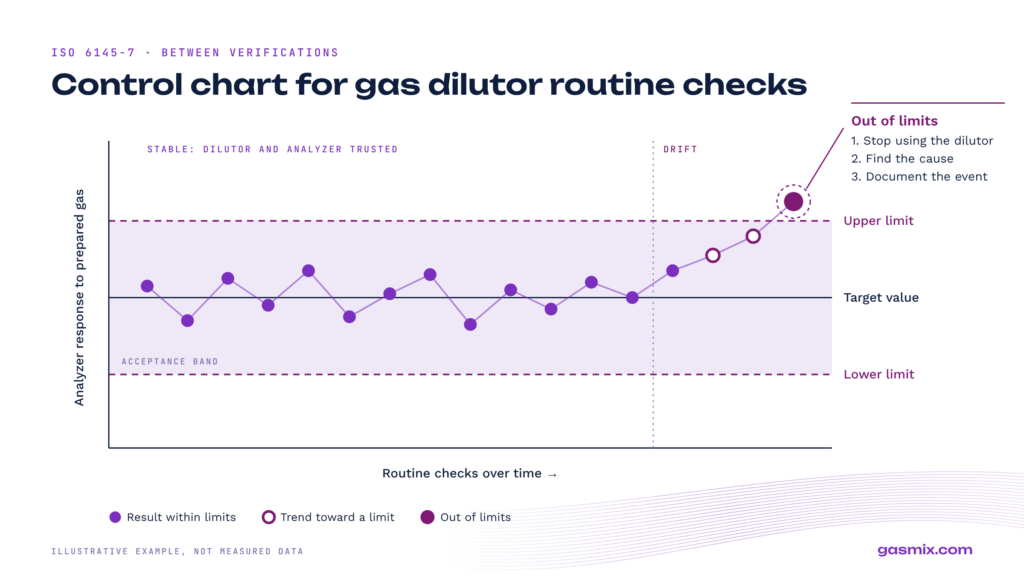
The unit producing the calibration gas has to be designed, developed and manufactured to be accurate in production. That's required — but not enough on its own. Accuracy must be proven, checked and verified throughout the lifetime of the unit, and correction may be necessary at some point. Every step of manufacturing, final testing, and ongoing use has to follow the same rules.
What technology is behind on-demand calibration gas generation?
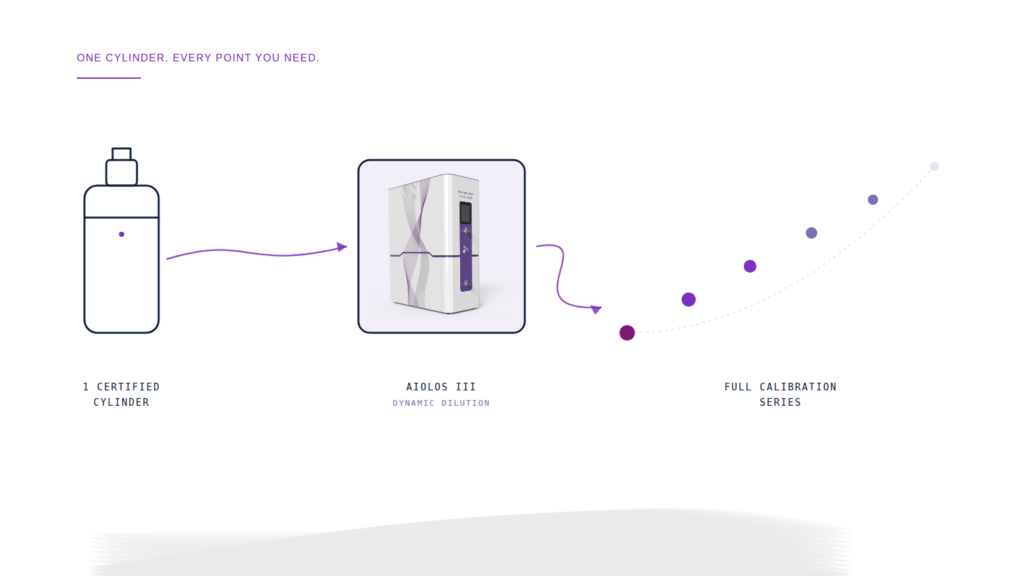
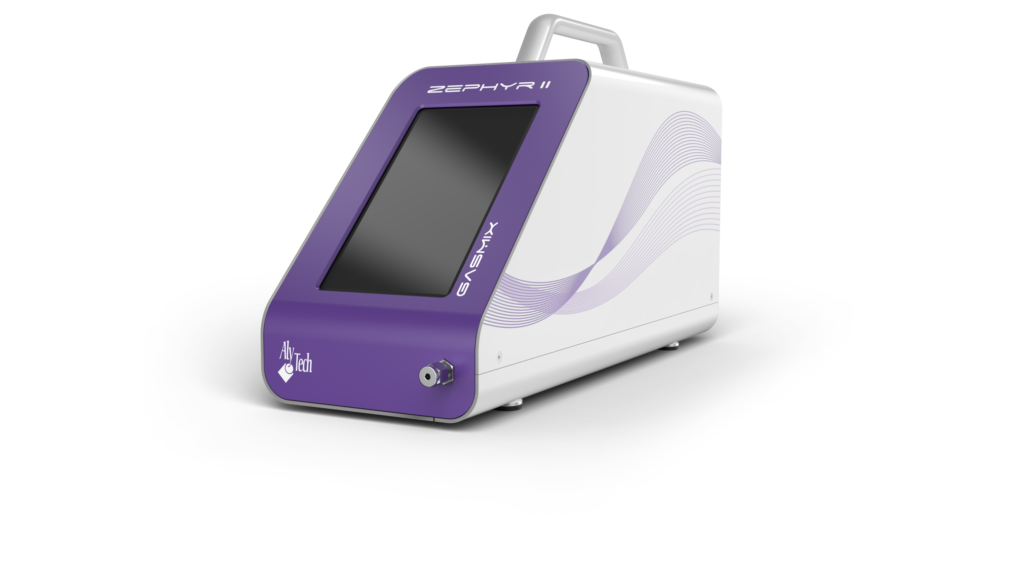
The gases are prepared in situ, on demand, by blending and/or diluting pure gases — or concentrated certified calibration gases — using Mass Flow Controllers (MFCs), following the ISO 6145-7 method.
The final concentration is only as good as the flow values of the gases being mixed. The mixing process itself then has to be efficient and leave the analytes/compounds unaffected until they reach the delivery point.
How is flow accuracy established on each MFC?
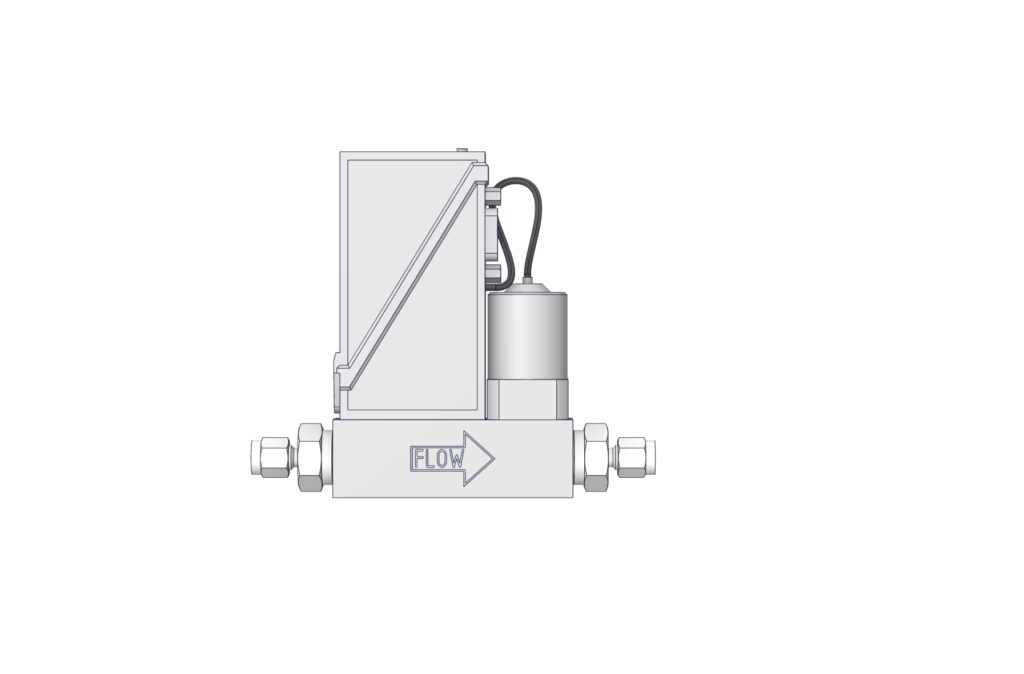
Flow accuracy is ensured through a proprietary MFC calibration method. Each MFC is calibrated on the specific gas or gas mixture it will run — pure gases or pre-existing mixes. This calibration is performed by measuring flow through a NIST-certified volumetric flowmeter, across up to 400 flow setpoint values, for each gas and each MFC.
How is the diluter's output verified analytically?
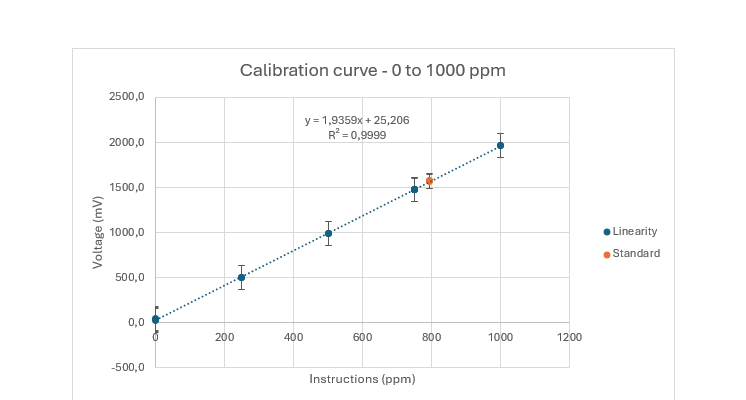
The metrological calibration is followed by an analytical verification step. The calibrated MFCs produce a calibration gas that is sent to a validated analyzer, and the read values are compared to the expected values. In a perfect case, the slope of that curve is 1.0.
Certified primary gas standards, prepared gravimetrically, are used to judge the diluter's performance against an independent reference.
How do you cross-check a diluter against a certified standard?
The final cross-verification step is to inject two calibration gases on the same analyzer, in the same sequence:
- one coming from a certified cylinder,
- the other, at the same nominal concentration, produced by the diluter from a concentrated certified gas.
The two concentration values should match, within an acceptable, pre-defined error margin.
The table below is a real example of that cross-check: three repeated injections of a standard instruction concentration of 794.1 ppm, compared against the diluter's calculated concentration, with the relative deviation shown for each run.
What error margin should you expect?
"Matching concentrations" is a useful shorthand, but it's not a precise one — two independently generated concentrations will never overlap exactly. Depending on the equipment, the compounds involved, the dilution ratio, the sample line length and other factors, a well-run quality procedure will define an acceptable error margin, typically in the range of 0.1% to 2% of the targeted concentration.
| Standard instructions (ppm) | 794,1 | 794,1 | 794,1 |
| Mean value (mV) | 1571,8 | 1573,7 | 1573,0 |
| Calculated concentration (ppm) | 798,9 | 799,9 | 799,5 |
| Relative deviation (%) | 0,6 | 0,7 | 0,7 |
FAQ
What standard governs this dilution method?
ISO 6145-7, the reference method for generating calibration gas mixtures using dividing-flow techniques (dynamic methods using capillaries or critical orifices/MFCs).
Is a gas diluter as accurate as a certified cylinder?
It can match a certified cylinder within a defined error margin, but that has to be demonstrated on your specific application — through MFC calibration, analytical verification, and a direct cross-check against a certified standard, not assumed from the datasheet alone.
How often should accuracy be re-verified?
Accuracy should be checked and verified throughout the life of the instrument, not just at commissioning — correction may be needed at some point, and the manufacturing/testing/use chain should be re-validated periodically as part of your quality procedure.