

The most common gas calibration compliance mistake is relying only on the MFC calibration certificate and the ISO 6145-7 two-year verification, with no checks in between. Auditors want evidence that the calibration gas was accurate on the day it was used. To stay audit-ready, labs should monitor their gas dilutor regularly, stop using it at the first sign of drift, and document every check.
- An MFC calibration certificate proves performance at the time of calibration only.
- ISO 6145-7 recommends, but does not require, verification and/or recalibration every two years.
- Routine interim checks with an external flowmeter or a calibrated analyzer close the gap between verifications.
- At the first sign of drift, the gas dilutor should be taken out of service until the cause is found.
- A control chart and a log of every event are the evidence auditors look for.
What do auditors check on a gas dilution system?
Auditors check how confident a lab can be in the accuracy of the calibration gas it prepares, and what evidence supports that confidence. The answer must rest on reference documents: the method, applicable standards and the lab's own records.
For a dynamic gas dilution system, the reference method is ISO 6145-7. It describes how to operate and monitor the unit.
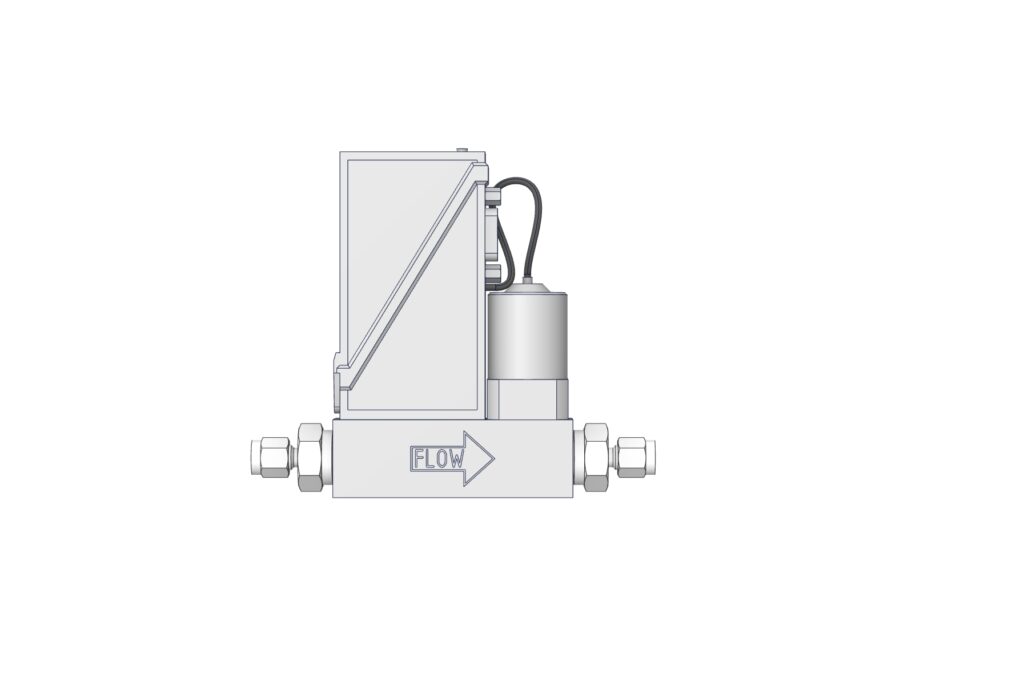
Definition: Mass flow controller (MFC). An MFC is a device that measures and controls the flow of a gas. In a dynamic gas dilutor, MFCs set the flows of the source gas and the diluent gas, which determines the final concentration.
On GasMix gas dilutors, the MFCs are calibrated with a NIST-traceable certified volumetric flowmeter. A copy of that flowmeter's certificate is included in the documentation delivered with every unit.
What are the most common gas calibration compliance mistakes?
Treating the MFC calibration as permanent proof
An MFC calibration proves how the MFC performed at the time of calibration, not afterwards. No flow control is perfectly stable over time. What matters is that flow values stay within the guaranteed drift and uncertainty values.
treat the certificate as a starting point and plan how you will show stability afterwards.
Using the ISO 6145-7 two-year recommendation as the only checkpoint
ISO 6145-7 does not require regular recalibration. It recommends verification and/or recalibration every two years. Relying on that recommendation alone leaves a long period with no evidence of performance, which is a weak position in an audit.
go beyond the method and add your own interim checks.
Running no routine checks between verifications
Labs can monitor a gas dilutor between verifications in two simple ways:
- Measure the flows with an external flowmeter.
- Check the response of a calibrated analyzer to a prepared gas at regular intervals.
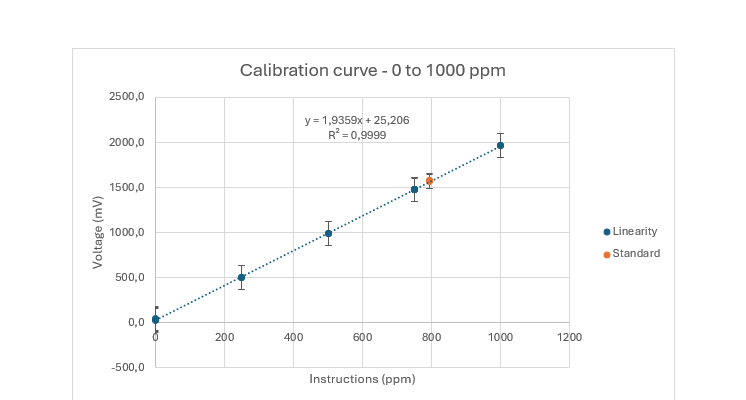
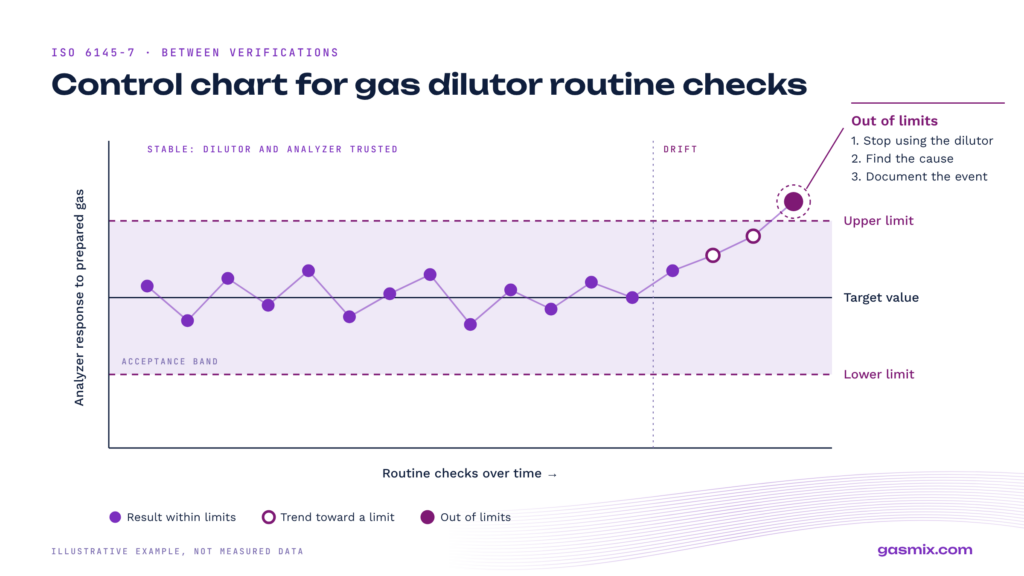
If the response stays stable within the expected error, both the gas dilutor and the analyzer can be considered stable.
Continuing to use the gas dilutor after a drift appears
If the analyzer response drifts over time, use of the gas dilutor should stop until the cause is identified, whether it comes from the dilutor or the analyzer. Auditors value this discipline: from the first sign of a performance change, the dilutor is no longer trusted until the reason is known.
Checking without documenting
A check that is not recorded does not exist for an auditor. A control chart, a log of every verification and the traceability of every event (drift, investigation, corrective action) turn good practice into proof of compliance.
Calibration, verification and routine check: what is the difference?
| Activity | What it proves | When | Required by ISO 6145-7? |
|---|---|---|---|
| MFC calibration | MFC accuracy at the time of calibration | At delivery and at recalibration | Recommended every two years |
| Verification | MFCs still within specification | Recommended every two years | Recommended, not mandatory |
| Routine check | Stability between verifications (flowmeter or analyzer) | Defined by the lab's own procedure | Not specified; good practice |
How can labs avoid gas calibration compliance mistakes?
Labs avoid these mistakes by combining periodic verification with documented routine checks. A simple checklist:
- Keep the MFC calibration certificate and the reference flowmeter traceability certificate on file.
- Plan ISO 6145-7 verification or recalibration at least every two years.
- Define a routine interim check (external flowmeter or calibrated analyzer response) in your internal procedure.
- Plot the results on a control chart with defined acceptance limits.
- Take the gas dilutor out of service at the first out-of-limit result and record the investigation.
FAQ
Does ISO 6145-7 require regular recalibration of a gas dilutor?
No. ISO 6145-7 recommends verification and/or recalibration every two years but does not make it mandatory.
How often should a gas dilutor be checked between calibrations?
ISO 6145-7 does not set an interim frequency. Each lab should define one in its internal procedure, based on how often the unit is used and how critical the measurements are, and apply it consistently.
How do you know whether a drift comes from the gas dilutor or the analyzer?
Check each one independently: measure the dilutor flows with an external flowmeter, or check the analyzer against a separate certified standard.
What documentation proves a gas dilutor is under control during an audit?
The MFC calibration certificate, the traceability certificate of the reference flowmeter, a control chart of routine checks, and a record of any drift and corrective action.
Is an MFC calibration certificate enough for an audit?
Not on its own. It proves performance at the time of calibration. Auditors also expect evidence that the system stayed within specification between calibrations.
Preparing for an audit?
Talk to our team about ISO 6145-7 documentation and verification of your GasMix gas dilutor.
Contact GasMix