

Siloxane Calibration Gas for Biogas: Generate D4 Standards On Site from the Liquid
A siloxane calibration gas is difficult to buy. Cylinders are expensive, slow to arrive, available in few concentrations, and they do not keep long. A joint study between Axel’One (chemistry and environment platform, Lyon) and AlyTech shows another route: vaporize liquid siloxane and dilute it on site to the required concentration.
Why do siloxanes matter in biogas?
Siloxanes are volatile silicon compounds released by detergents and cosmetics. They end up in landfill gas and in sewage sludge digesters. When biogas is burned, they turn into silica deposits that wear engines and foul equipment. For biomethane injected into the grid, EN 16723-1 limits total silicon to less than 1 mg/m³.
Octamethylcyclotetrasiloxane (D4) is one of the siloxanes most often found in biogas. Operators measure siloxanes to protect gas engines, to check that activated carbon filters are not saturated, and to prove biomethane quality before injection.
Why are siloxane calibration cylinders a problem?
Siloxanes are heavy, sticky molecules. They adsorb on cylinder walls and tubing, so stable low-level standards are hard to make. As a result, siloxane cylinders are expensive and slow to obtain, they come in few concentrations, and their stability is limited. A multi-point calibration therefore means buying several cylinders and tracking an expiry date for each one.
How do you generate a siloxane standard from the liquid?
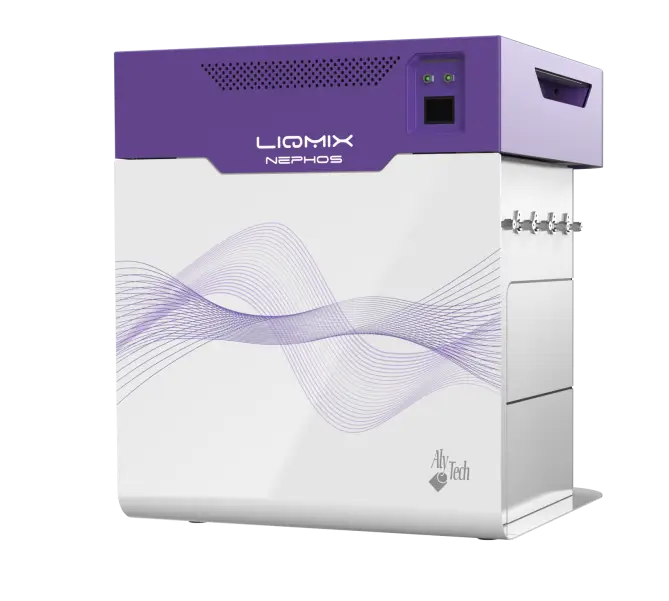
The NEPHOS doses the liquid siloxane with a Coriolis mass flow meter, vaporizes it in a carrier gas, then dilutes it with mass flow controllers. A heated line keeps the mixture in the gas phase up to the analyzer. On the NEPHOS, a second dilution stage reaches low concentrations without changing the liquid flow.
In the study, a single liquid flow of 1.061 g/h of D4 (98 % purity, CAS 556-67-2) produced six levels, from 5 ppm down to 0.5 ppm. Only the flow sent to the second stage was changed:
Table 1. Settings used for the six calibration levels
| Level | D4 concentration | Liquid flow | Carrier gas | 1st stage output | 2nd stage dilution |
|---|---|---|---|---|---|
| 1 | 5 ppm | 1.061 g/h | 1534.0 NmL/min | 17.6 NmL/min | 2985.9 NmL/min |
| 2 | 4 ppm | 1.061 g/h | 1534.0 NmL/min | 14.1 NmL/min | 2989.4 NmL/min |
| 3 | 3 ppm | 1.061 g/h | 1534.0 NmL/min | 10.6 NmL/min | 2993.0 NmL/min |
| 4 | 2 ppm | 1.061 g/h | 1534.0 NmL/min | 7.0 NmL/min | 2996.5 NmL/min |
| 5 | 1 ppm | 1.061 g/h | 1534.0 NmL/min | 3.5 NmL/min | 3000.0 NmL/min |
| 6 | 0.5 ppm | 1.061 g/h | 1534.0 NmL/min | 1.8 NmL/min | 3001.8 NmL/min |
The software calculates the flows for each target concentration and records them in a report, so every calibration point is documented.
What results did the calibration give?
On an Agilent 7890B GC-FID, the six levels gave a linear calibration curve with R² above 0.999. The experiment was run twice and both curves were similar. Because the standard is generated continuously, several chromatograms can be recorded on each level, which gives the repeatability directly:
Table 2. GC-FID response and repeatability per level
| D4 concentration | Mean peak area | RSD |
|---|---|---|
| 5 ppm | 121 | 1.4 % |
| 4 ppm | 97 | 1.1 % |
| 3 ppm | 73 | 1.0 % |
| 2 ppm | 49 | 1.3 % |
| 1 ppm | 25 | 1.2 % |
| 0.5 ppm | 13 | 3.8 % |
GC conditions: DB-1 column, 10 m × 0.53 mm, 2.65 µm film, isothermal at 80 °C, splitless injection, 3.5 min run.
The same approach was used on a micro GC with a TCD detector, from 50 ppm down to 3 ppm. The lower limit came from the micro GC’s quantification limit, not from the generator.
Which concentration range does this cover?
The study demonstrates D4 standards from 0.5 to 50 ppm, which is about 6.6 to 660 mg/m³ of D4. This is the range found in raw biogas, for engine protection and filter monitoring. Landfill gas measurements published on the US EPA website range from 4.5 to 161 mg/m³ of siloxanes.
The biomethane specification is lower. Less than 1 mg/m³ of silicon corresponds to less than about 0.2 ppm of D4. The 0.5 ppm floor in this study was set by the GC-FID, not by the NEPHOS. If you need levels below 0.5 ppm, tell us your detector and target range, and we will tell you what is achievable.
Can a GC-FID replace GC-IMS for siloxane analysis?
ISO 2613-2:2023 describes siloxane measurement in biomethane by GC-IMS. For a control laboratory, the study suggests a simpler option: a standard GC-FID, calibrated with standards generated on site. The FID gave a linear response over 0.5 to 5 ppm with repeatability between 1.0 % and 3.8 %. Validate it against your own quality requirements before you change methods.
What does the NEPHOS bring compared with cylinders?
- A small bottle of pure siloxane replaces a set of cylinders. Each concentration is set in the software.
- There is no shelf life to manage: the standard is generated when the sequence starts.
- Multi-point calibration sequences can be synchronized with a GC or another analyzer and run without an operator.
- The mass flow controllers are factory calibrated with NIST-traceable procedures. The software calculates and reports the uncertainty of each generated concentration, and the method complies with ISO 6145-7.
- With one or two liquid channels and up to four gas channels, H₂S, CO₂ or methane can be added to reproduce a real biogas matrix.
Table 3. Main NEPHOS specifications
| Item | Value |
|---|---|
| Liquid channels | 1 or 2 |
| Liquid flow meter | Coriolis, 0.5 to 5 g/h or 0.5 to 200 g/h |
| Gas channels | 1 to 4 |
| Dilution factor | up to 10⁸ |
| Heated output line | 2 m as standard, other lengths possible |
| Wetted parts | Sulfinert treated |
| Connectors | Swagelok 1/8", 1/16" and 1/4" |
| Software | AlySoft on Windows 10 or higher, Ethernet |
Send us your siloxane list, your analyzer and your target range. We will propose a configuration and tell you which levels you can generate.
Get a configuration proposalFrequently asked questions
Which siloxanes can the NEPHOS generate?
The study used D4. The NEPHOS accepts pure liquids or mixtures of liquids, so other volatile siloxanes can be vaporized the same way. Tell us which compounds you need and we will check the conditions with you.
What concentration range was demonstrated for D4?
From 0.5 to 5 ppm on GC-FID, and from 3 to 50 ppm on micro GC with TCD. Below 0.5 ppm, the limit came from the detector used in the study, not from the generator.
Why not simply buy siloxane cylinders?
For a single concentration used often, a cylinder can be enough. For a multi-point curve, or for levels that change from one project to the next, generating the siloxane calibration gas from the liquid avoids buying, storing and tracking several cylinders.
Is the generated concentration traceable?
Yes. The liquid is dosed by a Coriolis mass flow meter, and the gases by mass flow controllers factory calibrated with NIST-traceable procedures. The software calculates and reports the uncertainty of each concentration.
Can I calibrate a GC automatically overnight?
Yes. The software runs multi-point sequences and can be synchronized with a GC, a micro GC or another analyzer, so the calibration runs without an operator.