


LPG & LIQUEFIED GAS ANALYSIS
AURA II — LPG Vaporizer for GC, microGC and Elemental Analyzers
Bench-top vaporization of LPG and liquefied gases into a stable, 100 % gas phase.
LPG vaporization — Make sure there is no discrimination.
When LPG is drawn from a cylinder without controlled vaporization, the light ends flash off first and the heavy ends stay behind. The composition reaching the analyzer is no longer the composition of the sample, and sulfur or hydrocarbon results drift from one injection to the next. AURA II removes that variable: the sample is vaporized under regulated temperature and pressure, then transferred to the analyzer through a heated line so that nothing recondenses on the way.
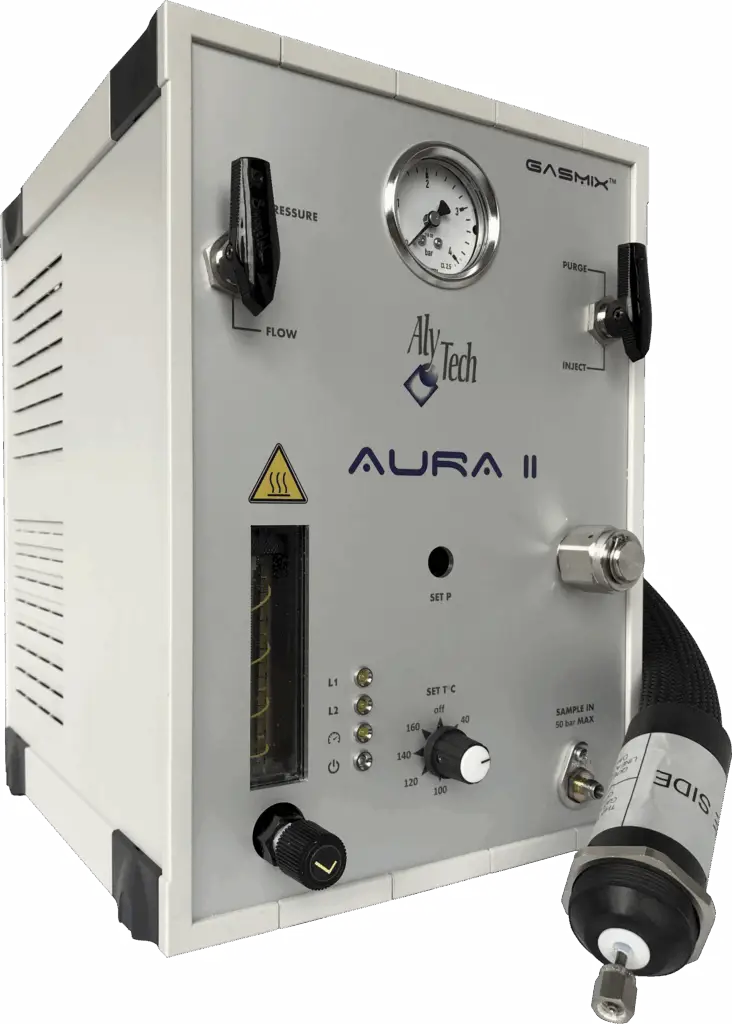
Aura II is a bench-mounted LPG vaporizer that converts liquefied gases into a stable, contamination-free gas phase for precise analysis on GC, microGC and elemental analyzers. Compatible with GasMix™ AIOLOS for automated multi-point calibration per ASTM D6667/D7551.
How do you run multi-point sulfur calibration on LPG per ASTM D6667 and D7551?
Total sulfur methods require several concentration levels. Rather than buying one cylinder per level, AURA II can be paired with a GasMix Aiolos mixer-diluter: a single certified standard is diluted automatically to each point of the curve and injected in sequence, while AURA II keeps the LPG sample fully vaporized. The full calibration runs unattended, with each level logged.
Both instruments share the same heated path, so the sample stays in the gas phase from the cylinder to the injection point. See how automated multi-point calibration works, or the AIOLOS mixer-diluter it relies on.
Why must LPG be vaporized before GC or elemental analysis?
Liquefied petroleum gas boils over a range, not at a single point. If the sample is allowed to vaporize on its own inside a cylinder or a line, propane leaves before butane and the heavier components are left behind. Analyzing that vapour gives a composition that does not represent the liquid. A vaporizer converts the whole sample at once, under controlled temperature, so the vapour reaching the detector has the composition of the liquid it came from.
What causes sample discrimination when sampling LPG?
Discrimination happens whenever part of the sample changes phase at a different moment from the rest. The three usual causes are partial vaporization in the cylinder or the regulator, cold spots between the vaporizer and the analyzer where heavy ends recondense, and adsorption of trace compounds such as sulfur species on untreated metal surfaces. AURA II addresses all three: full vaporization at 40 to 160 °C, internal lines and a 1 m transfer line heated at 120 °C, and an inert-treated flow path from inlet to outlet.
How does AURA II deliver 100 % gas phase to the analyzer?
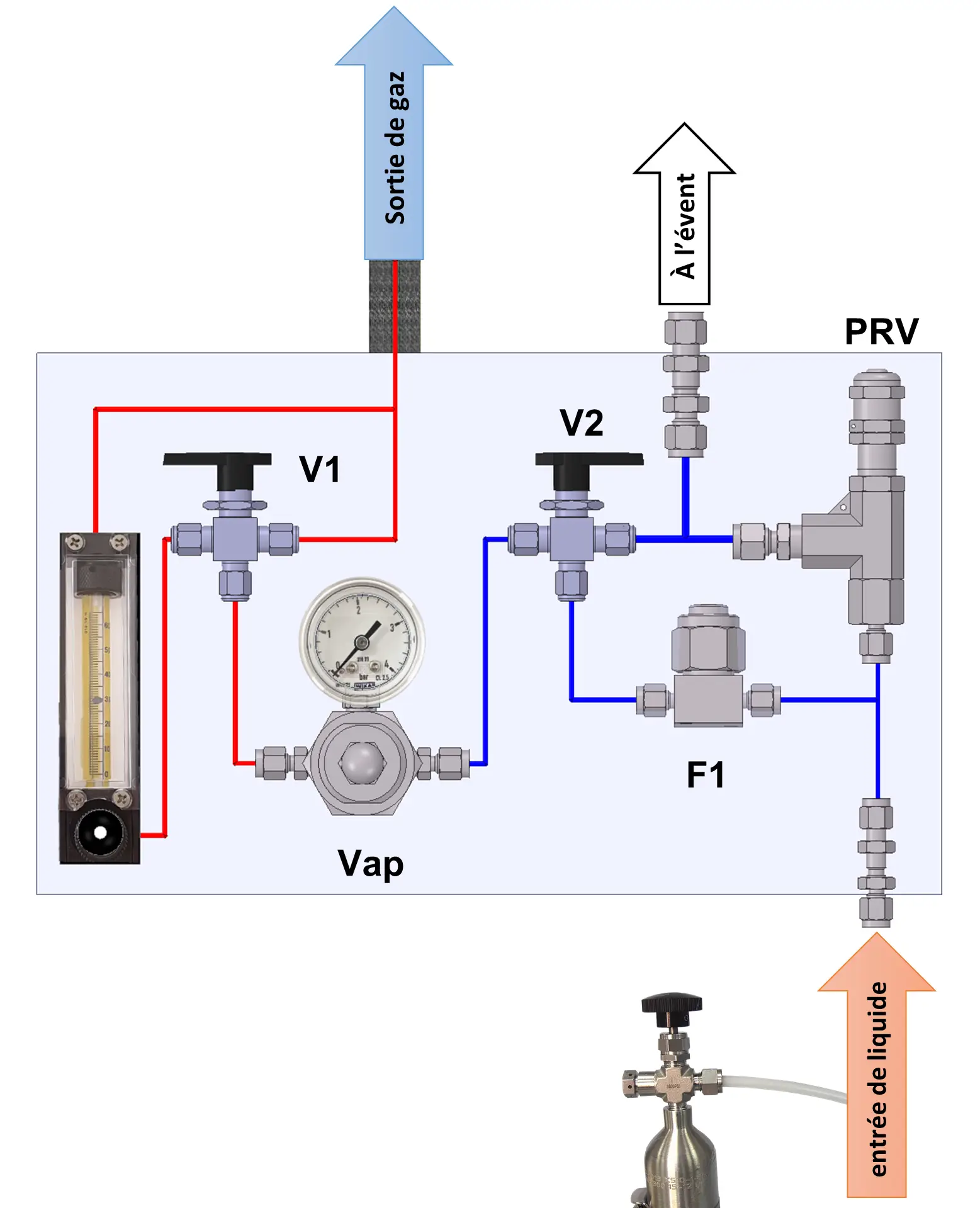
The sample enters through a 0.5 µm stainless steel filter at 2 to 50 bar and is vaporized in a heated chamber regulated between 40 and 160 °C. Every internal line is held at 120 °C, and the 1 m insulated output line is heated to the same temperature up to the point of delivery. Outlet pressure is reduced to about 1 bar abs and flow is regulated between 20 and 200 cc/min.
AURA II technical specifications
| Parameter | Value |
|---|---|
| Vaporizer temperature, max | 160 °C (320 °F) |
| Temperature regulation range | 40–160 °C (104–320 °F) |
| Internal gas lines | Heated at 120 °C (248 °F) |
| Output gas line | Insulated transfer line, 1 m, heated at 120 °C (248 °F) |
| Inlet pressure | 2 bar min (30 psi) – 50 bar max (725 psi) |
| Outlet pressure | 1 bar abs typical (14 psi), 3 bar max (43 psi) |
| Output flow | 20–200 cc/min (methane) |
| Warm-up time | Typically 15 minutes |
| Heating power | 100 W |
| Power supply | 24 VDC, external AC/DC adapter — 110–230 VAC, 2.4 A, 50–60 Hz |
| Connections | 1/8" inlet; 1/8" outlet line; 1/4" vent |
| Inlet filter | Stainless steel, 0.5 µm |
| Wetted surfaces | Entire gas flow path is inert-treated |
| Dimensions | 22 × 27 × 31 cm (8.6 × 10.6 × 12.2 in) |
| Weight | 8 kg (18 lb) |
| Reference methods | ASTM D6667, ASTM D7551 |
Send us your analyzer model, your sample type and the sulfur or hydrocarbon range you work in. We will confirm compatibility and the recommended configuration.
Check compatibilityHow does AURA II deliver 100 % gas phase to the analyzer?
A pressure regulator, even heated, controls pressure. It does not guarantee that the whole sample has changed phase. A water bath vaporizes but leaves the transfer line cold. A cylinder of pre-mixed calibration gas avoids vaporization entirely but fixes you to one concentration and one matrix. A dedicated vaporizer with a heated line is the option that keeps the sample representative from the cylinder to the detector.
| Approach | Full phase change | Heated to the analyzer | Multi-level calibration | When it is enough |
|---|---|---|---|---|
| Pressure regulator alone | No — partial, uncontrolled | No | No | Light, single-component gases well above their boiling point |
| Heated / vaporizing regulator | Partial | Not past the regulator | No | Occasional sampling where heavy ends are not critical |
| Water or oil bath | Yes | No — the line stays cold | No | Manual sampling with a very short transfer path |
| Pre-mixed calibration cylinder | Not applicable | Not applicable | One cylinder per level | A single fixed concentration in a stable matrix |
| Dedicated vaporizer (AURA II) | Yes, regulated 40–160 °C | Yes — 120 °C to the point of delivery | Yes, with a GasMix AIOLOS mixer-diluter | Routine or traceable LPG analysis, trace sulfur, method development |
Which laboratories use AURA II?
AURA II supports petroleum, environmental and research laboratories — enabling traceable LPG vaporization, analyzer-ready gas-phase transfer and automated calibration with Aiolos.
Refineries & LPG terminals
Total volatile sulfur on propane, butane and commercial LPG, with calibration curves generated on site.
GC / microGC / GC-MS benches
Detailed hydrocarbon analysis of liquefied samples with guaranteed vapour-phase injection.
Research & method development
Repeatable vaporization of LPG and other liquefied gases for trace-level studies and gaseous sample preparation.
Elemental analyzers
Sample introduction and calibration for total sulfur and trace elements in liquefied hydrocarbons.
FAQ — AURA II
Most asked questions about LPG vaporization, analyzer integration and safety.
Because LPG boils over a range. Left to vaporize on its own, the light components leave first and the sample composition changes as it is consumed. Controlled vaporization converts the whole sample at once, so the vapour analyzed matches the liquid sampled.
Sample discrimination is any loss or enrichment of part of the sample between the cylinder and the detector. It comes from partial vaporization, recondensation in cold sections of tubing, and adsorption of trace compounds on untreated surfaces. It shows up as poor repeatability, especially on heavy ends and on sulfur species.
A regulator controls pressure, not phase. Expansion through a regulator cools the sample, which encourages partial vaporization and recondensation downstream. A vaporizer applies regulated heat to the whole sample and keeps the transfer line hot, which a regulator does not.
It depends on the heaviest component present. AURA II is regulated between 40 and 160 °C (104–320 °F), which covers commercial propane and butane mixtures as well as heavier liquefied samples. Internal lines and the output line are held at 120 °C (248 °F) to prevent recondensation.
By heating every surface the vapour touches, up to the injection point. AURA II heats its internal lines and supplies a 1 m insulated transfer line at 120 °C. Any unheated fitting or length of tubing added downstream becomes a cold spot where heavy ends drop out.
GC, microGC, GC/MS and elemental analyzers, including total sulfur and trace element instruments. The outlet is regulated between 1 and 3 bar abs at 20 to 200 cc/min, with 1/8" connections, which suits standard analyzer sampling inlets.
By pairing AURA II with a GasMix Aiolos mixer-diluter. A single certified standard is diluted to each concentration of the curve and injected automatically in sequence, while AURA II keeps the sample fully vaporized. This supports ASTM D6667 and D7551 workflows from one cylinder.
Vaporization from 40 to 160 °C, inlet pressure 2 to 50 bar, outlet 1 bar abs typical and 3 bar maximum, output flow 20 to 200 cc/min on methane, warm-up around 15 minutes. Full specifications are in the table above.
Ready to Vaporize with Confidence?
Bring safe, traceable LPG vaporization to your bench