

Hydrogen Fuel Purity Calibration (ISO 14687)
How to calibrate hydrogen impurity analysers at trace levels, on demand and traceably.
ISO 14687 sets impurity limits for fuel-cell hydrogen down to the ppb range, where the calibration standard, not the analyser, becomes the hard part. Commercial trace-level cylinders are expensive, slow to deliver, short-lived and carry 10 to 20 % certified uncertainty. Dynamic dilution (ISO 6145-7) solves it: from one stable, concentrated parent standard, a GasMix diluter generates any impurity concentration on demand, with automatic uncertainty and an audit trail. Two independent application notes show it working, sulfur and ammonia at single-ppb levels on a PAC SeNSe2 detector, and permanent-gas impurities meeting ISO 14687 detection limits on a Da Vinci DVLS hydrogen analyser.
Background → Trace-level gas generation
Why hydrogen fuel purity limits are so low
A fuel cell has to sustain around 200,000 km (125,000 miles) without major service. Impurities in the hydrogen deposit on the catalyst and cut its activity cumulatively over that lifetime. To set limits, engineers calculate the maximum tolerable mass of each contaminant across the vehicle's life, then divide by the total hydrogen consumed. The result, written into ISO 14687 for PEM fuel cells, is a set of concentration limits in the ppb to low-ppm range, some sub-ppb.
That creates two problems for the analytical chemist: finding an analyser that detects impurities at those levels, and, harder still, obtaining reliable, traceable calibration gases at the same concentrations.
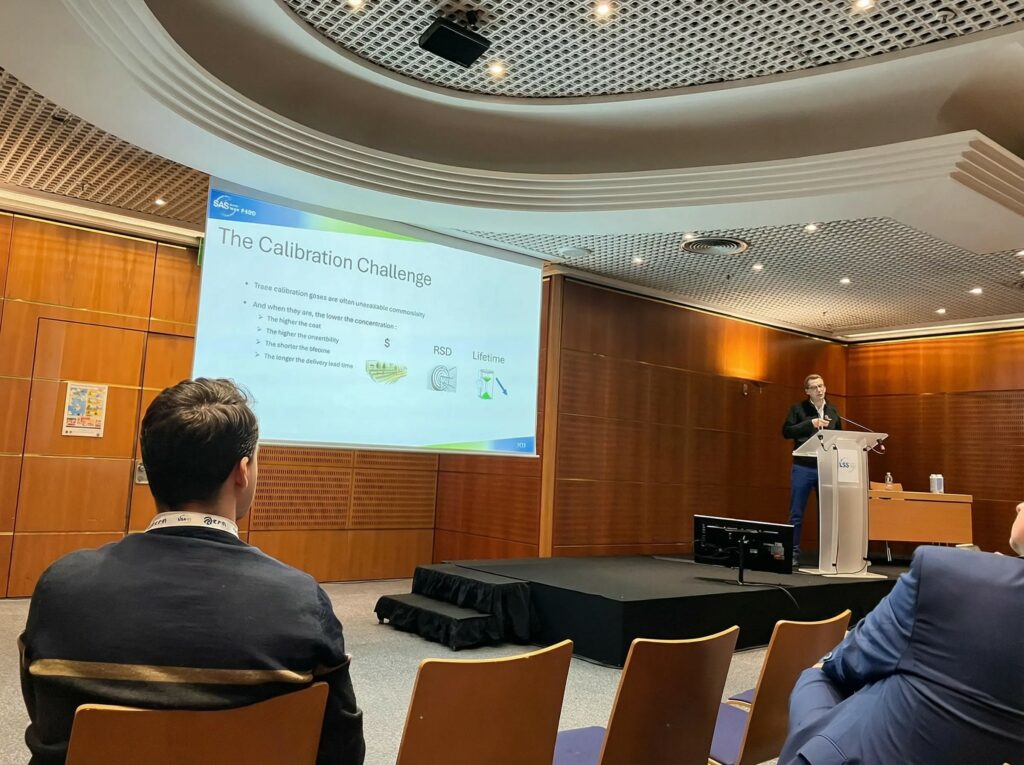
The problem with commercial certified standards
- Long, variable lead times of several weeks.
- Short shelf life, as low as 3 months for reactive trace compounds.
- High certified uncertainty of 10 to 20 %, which propagates straight into your measurement uncertainty.
- Very high cost, rising as the target concentration falls.
- Wrong concentration, often one to two orders of magnitude off target, forcing extra manual dilution.
The gas diluter solution: any concentration, on demand
Dynamic dilution under ISO 6145-7 starts from a single concentrated, certified parent standard, which is stable, comparatively inexpensive, certified for up to five years and with a narrow uncertainty. A ZEPHYR II or AIOLOS III diluter then produces any concentration between the parent standard and the diluent, on demand, with documented traceability.
-
Exact target concentrationGenerate the level you need and bracket unknown samples, instead of settling for a catalogue value.
-
Fewer cylindersOne parent standard replaces a shelf of certified trace cylinders: less stock, simpler logistics, better safety.
-
Full traceabilityAudit trail, automatic uncertainty calculation and PDF reporting on every mixture.
-
Aggressive compoundsCompatible with reactive species: sulfur compounds, NOx, NH3 and VOCs.
Calibrate your hydrogen analyser at ppb levels
Tell us your target impurities, ISO 14687 limits and analyser, and we will confirm the diluter configuration and the expected uncertainty.
Request a quote Start the Product FinderISO 14687 impurity limits and what an analyser must reach
The permanent-gas impurities below were measured on a Da Vinci DVLS hydrogen analyser calibrated with an AlyTech Gas Mix standard. The detection limits sit comfortably under the ISO 14687 specification for each compound.
| Impurity | ISO 14687 limit (µmol/mol) | Detection limit (µmol/mol) |
|---|---|---|
| Argon | 300 | < 0.1 |
| Oxygen | 5 | < 0.1 |
| Nitrogen | 300 | < 0.1 |
| Carbon monoxide | 0.2 | 0.1 |
| Methane | 100 | < 1 |
| Carbon dioxide | 2 | < 1 |
| Heavy hydrocarbons | 2 | < 1 |
| Helium | 300 | < 50 |
Proven results: two application notes
Sulfur and ammonia at single-ppb levels (PAC SeNSe2)
In a joint note by PAC and AlyTech, a GasMix generated traceable calibration levels for a PAC SeNSe2 sulfur/nitrogen chemiluminescence detector. Sulfur species were quantified at single-ppb levels and ammonia below 100 ppb, with stable, linear and equimolar response:
| Component | Mean | Target | Bias | RSD |
|---|---|---|---|---|
| H2S | 3.76 ppb | 3.59 ppb | +4.71 % | 3.2 % |
| COS | 4.14 ppb | 4.00 ppb | +3.62 % | 2.9 % |
| SO2 | 4.11 ppb | 4.00 ppb | +2.87 % | 3.4 % |
| NH3 | 96.30 ppb | 100.00 ppb | −3.70 % | 7.1 % |
| Total sulfur | 12.02 ppb | 11.59 ppb | +3.70 % | 1.0 % |
Permanent-gas impurities on a hydrogen analyser (Da Vinci DVLS)
In a Da Vinci Laboratory Solutions note, a DVLS hydrogen analyser (PDHID, FID and TCD across three channels) was calibrated with an AlyTech Gas Mix standard. Over 12 repeat runs, repeatability stayed well under 5 % RSD for every impurity:
| Impurity | Average | RSD (n=12) |
|---|---|---|
| Carbon monoxide | 10.2 | 0.13 % |
| Methane | 10.1 | 0.26 % |
| Heavy hydrocarbons | 10.0 | 0.25 % |
| Carbon dioxide | 10.1 | 0.31 % |
| Argon | 102 | 0.94 % |
| Oxygen | 10.4 | 2.30 % |
| Nitrogen | 109 | 2.48 % |
| Helium | 94.9 | 3.58 % |
Chromatographic resolution was 2.0 for argon/oxygen and 3.4 for helium/hydrogen, with an analysis time of about 20 minutes.
Commercial cylinders vs. dynamic dilution for ISO 14687
| Criterion | Commercial trace cylinders | Dynamic dilution (GasMix) |
|---|---|---|
| Lead time | Several weeks | On demand, on site |
| Shelf life | As low as 3 months (reactive species) | Parent standard certified up to 5 years |
| Certified uncertainty | 10 to 20 % | Narrow, propagated and reported per mixture |
| Concentration | Fixed, often off target | Any level between parent and diluent |
| Cost at trace levels | Very high, rises as level falls | One parent standard, many levels |
| Reactive compounds (S, NOx, NH3) | Hard to certify and keep stable | Generated fresh, inert-treated path |
| Traceability | Supplier certificate | Audit trail, auto uncertainty, PDF report |
Which GasMix system for hydrogen purity work
For compact two-gas dilution, ZEPHYR II; for automated multi-gas dilution and multi-point sequences (the natural fit for a full ISO 14687 impurity panel), AIOLOS III; for complex mixtures up to 16+ channels, HURRICANE. The same method underpins trace-level gas generation and automated multi-point calibration. Not sure which fits your analyser? Choosing the right gas mixer walks through it, or the Product Finder recommends a configuration.
Frequently asked questions
Why are ISO 14687 hydrogen impurity limits at ppb levels?
Because impurities poison the fuel-cell catalyst cumulatively over the vehicle's life (around 200,000 km). ISO 14687 works out the maximum tolerable mass of each contaminant across that life and divides by total hydrogen consumption, which lands the limits in the ppb to low-ppm range, some sub-ppb.
Why not just buy certified trace-level cylinders?
At these levels they have long lead times (weeks), short shelf life (as little as 3 months for reactive species), high certified uncertainty (10 to 20 %), high cost, and often the wrong concentration. Dynamic dilution generates the exact level you need on demand from one stable parent standard.
How accurate and repeatable is dilution-based calibration here?
In the PAC SeNSe2 note, sulfur species at around 4 ppb showed bias of 2.9 to 4.7 % and RSD of 2.9 to 3.4 %, ammonia at ~96 ppb gave 7.1 % RSD, and total sulfur 1.0 % RSD. In the DVLS note, permanent-gas impurities over 12 runs stayed under 5 % RSD (0.13 to 3.58 %). Results depend on the analyser and compound.
Can it generate aggressive impurities like H2S and NH3?
Yes. The diluters are compatible with aggressive compounds (sulfur species, NOx, ammonia, VOCs) using inert-treated flow paths, and generate them fresh at the point of use, which avoids the drift and adsorption that plague reactive-species cylinders.
Is the calibration traceable and ISO-compliant?
Generation follows the ISO 6145-7 dynamic-dilution method; the parent standard is certified and NIST-traceable; and every mixture carries an automatic uncertainty calculation, an audit trail and a PDF report. This supports calibration to ISO 14687 impurity limits.
Which analysers has this been demonstrated with?
Two published notes: a PAC SeNSe2 sulfur/nitrogen chemiluminescence detector (sulfur and ammonia at ppb levels) and a Da Vinci DVLS hydrogen analyser with PDHID, FID and TCD (permanent-gas impurities against ISO 14687). The generic dilution approach applies to other hydrogen impurity analysers too.
Bring ISO 14687 calibration in-house
25+ years specifying gas dilution systems. Tell us your impurity panel and analyser, and we will spec the right GasMix, or start with the Product Finder.
Request a quote Start the Product FinderOr email gasmix@alytech.fr.
References: PAC SeNSe2 x GasMix application note (Boekee, Courthaudon); Da Vinci DVLS hydrogen analyzer application note (de Jonge). Figures cited are from those notes and depend on the analyser and compound. Standards: ISO 14687, ISO 6145-7. Instrument brand names are trademarks of their respective owners; interoperability is described without implied endorsement. GasMix, AlyTech.