

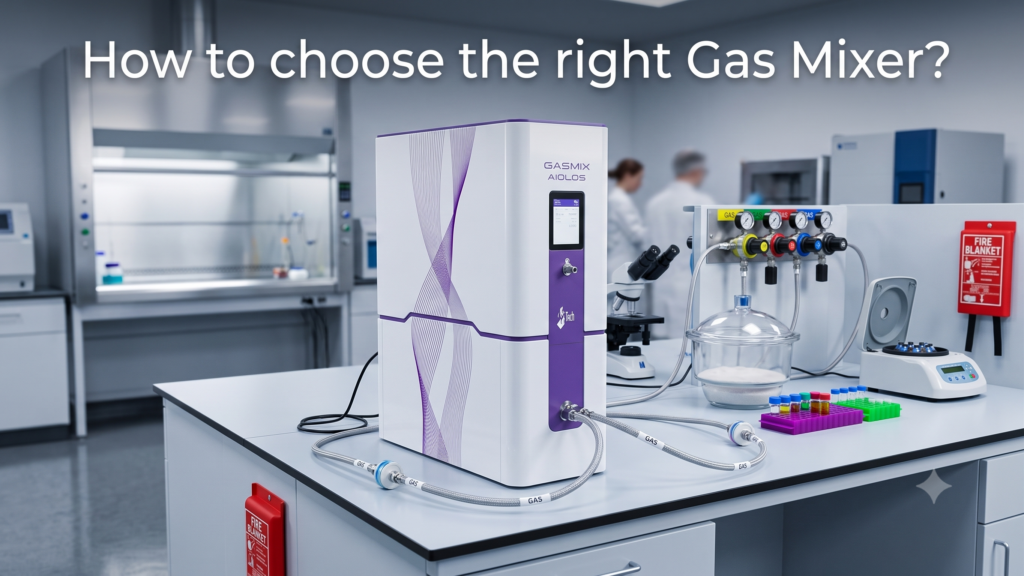
How to Choose the Right Gas Mixer for Your Laboratory: 7 Specs That Actually Matter
The right gas mixer is the one whose specifications match how your lab actually works. Seven specs decide it: the dilution ratio you need, how many gases you blend at once, your required concentration accuracy, the traceability and uncertainty you must document, whether the instrument has to drive your analyzer or GC, your cylinder consumption and budget, and the gas compatibility your analytes demand. Answer these seven before comparing models, and you specify an instrument that is neither over-built nor under-powered.
Once you have decided that dynamic dilution is the right approach for your lab, the real work begins: choosing the instrument. Below are the seven specifications to work through — and why each one changes the decision.
Not sure you need a gas mixer yet? → When cylinders are enough
The 7 specs that actually decide your gas mixer
1Dilution ratio : how far do you need to dilute?
This is the single most defining spec. Producing 50 % mixtures is a completely different instrument from generating ppb-level trace standards. GasMix™ systems reach dilution ratios up to 1:10 000 from a single certified cylinder. If your span crosses several decades — small and large dilutions from the same standard — you may need multiple flow ranges or multi-stage (cascade) dilution. Sizing the flow range wrong is the most common specification mistake, so it is worth choosing the right MFC flow range deliberately.
2Number of gases blended at once : how many channels?
A binary dilution needs two channels; a complex synthetic matrix for FTIR or engine-bench work may need far more. Size the channel count to the most complex mixture you realistically prepare, not the simplest. GasMix™ instruments span 2 channels (ZEPHYR II) up to 16+ (HURRICANE), with AIOLOS III covering 2 to 6.
3Concentration accuracy : how tight must each point be?
For calibration and linearity work, accuracy is the whole point. GasMix™ mass flow controllers hold ±1 % of setpoint across the range, with repeatability better than 0.1 %, and each MFC is factory-calibrated at 20 points per gas matrix. If your method tolerates looser figures, you can specify a simpler configuration; if it does not, this spec is non-negotiable.
4Traceability & uncertainty : do you need to prove every point?
Regulated and accredited labs must document not just the concentration but its uncertainty. Ask whether the instrument calculates and reports the maximum relative uncertainty for every concentration, and whether it keeps an audit trail. GasMix™ software does both automatically and complies with the ISO 6145-7 dynamic-dilution method — the difference between a result you can defend in an audit and one you cannot.
5Analyzer & GC integration : does it need to run unattended?
If calibration is a routine you repeat, manual operation is a hidden cost. Check for digital I/O synchronization so the mixer can trigger — and be triggered by — your GC, FTIR, µGC or gas analyzer, running full multi-point sequences with no operator present. AIOLOS III synchronizes through built-in digital I/O, which is what makes it possible to automate multi-point GC calibration.
6Cylinder consumption & budget : what is the payback?
Count your certified cylinders and your yearly calibration-gas spend, then estimate how much gas expires unused before its certificate lapses. This is where dynamic dilution pays for itself: one high-concentration standard replaces a shelf of intermediate cylinders. GasMix™ case studies show payback in about one year — the real lab profile further down shows exactly how those numbers add up.
7Gas compatibility : what are you actually flowing?
Reactive and aggressive species (trace sulphurs, NOx, ammonia, VOCs) demand inert-treated flow paths and the right seals. Confirm the instrument is rated for your most difficult analyte, not just your easiest — for VOC and BTEX work, for instance, a purpose-built system such as NEPHOS for BTEX & VOC standards exists precisely because a mixer that corrodes or adsorbs your target compound is worse than no mixer.
Find the instrument that fits your lab
Answer a few questions about your gases and dilution needs and get a matched configuration in minutes.
Start the Product FinderWhat questions should you answer before buying?
Priorities vary by application, organization size, and existing equipment, but every lab needs a clear answer to each of these before comparing models:
- How do I work now : pure gases, certified mixtures, or both?
- How many calibration-gas cylinders do I use today?
- What is my average yearly budget for calibration gases, and how much expires unused?
- Why do I need to dilute : unavailable concentrations, multilevel steps, or complex mixtures?
- Do I need to deliver calibration gas in sync with an automatic analyzer?
- How important is guaranteed concentration, and must I master the associated uncertainty?
The answers determine how advanced, automated, compliant, and closely monitored your instrument needs to be.
A real lab profile
Here is how one analytical chemist's answers mapped onto an instrument decision.
| Factor | Response |
|---|---|
| Current workflow | Pure gases and certified calibration gases |
| Cylinders needed | Nineteen |
| Yearly budget | 6,950 € (about 1,100 € per cylinder) |
| Certificate validity | 3 years |
| Gas used before expiry | Approximately 40 % |
| Dilution purposes | Reaching unavailable concentrations, producing multilevel steps, preparing complex mixtures |
| Analyzer integration | Yes — primarily a gas chromatograph, via software |
| Concentration guarantees | Central requirement; traceability essential |
With roughly 60 % of a 6,950 € annual spend expiring unused, a single high-concentration standard driving an automated, traceable dilution instrument recovers most of that waste — which is why this profile points squarely at a fully automated, ISO 6145-7-compliant system rather than a manual bench setup.
Homemade diluter vs. integrated gas mixer
| Factor | Homemade DIY diluter | AIOLOS III |
|---|---|---|
| Flow calculation | Manual, per mixture | Automatic, software-driven |
| Matrix correction | Approximate | Adjusted per gas matrix automatically |
| Operator presence | Required throughout | Not required once a sequence is running |
| Concentration range | Limited to MFCs on hand | 2 to 6 channels, ppb to % |
| Traceability | Not built in | Automatic audit trail |
| Uncertainty reporting | Manual, if done at all | Calculated and reported per concentration |
| Compliance | Not certified | ISO 6145-7 compliant |
| Analyzer integration | Custom wiring and scripting | Built-in digital I/O synchronization |
What does this kind of lab actually need?
A lab that consumes a shelf of certified cylinders, wastes most of each one, runs GC-coupled calibration, and must defend every concentration in an audit needs an instrument that automates flow calculation and matrix correction, builds and runs sequences unattended, and reports uncertainty and traceability for every point — exactly the specification AIOLOS III was built to meet. The right way to confirm the fit is to match your own answers against the seven specs above.
Get a configuration matched to your lab
The Product Finder turns your answers into a recommended instrument in a few minutes — or tell us your application and we will spec it for you.
Start the Product Finder Request a quoteFrequently Asked Questions
What's the difference between a gas mixer and a homemade dilution setup?
A homemade setup wires together two or more mass flow controllers and requires manual flow calculations, approximate matrix correction, and an operator present throughout. An integrated gas mixer like AIOLOS III automates flow calculation, matrix correction, sequence building, and audit-trail traceability in one system.
How many mass flow controllers does a gas mixer need?
It depends on the application. AIOLOS III supports 2 to 6 channels, so the instrument is sized to the number of gases and concentration ranges a lab needs to cover, rather than assembled by hand.
Can a gas mixer replace certified calibration gas cylinders entirely?
No. A certified cylinder remains the traceable reference. A gas mixer extends what one cylinder can do, producing multiple concentrations and complex mixtures dynamically, on demand, instead of stocking a separate cylinder for each one.
Does a gas mixer need to interface with an analyzer or GC?
Not always, but many labs need it. AIOLOS III can synchronize with GCs and other analyzers through digital I/O, running fully automated calibration sequences without manual intervention.
What guarantees come with the concentration a gas mixer produces?
Each mass flow controller in AIOLOS III is factory-calibrated at 20 points across its range, per gas matrix. The instrument automatically calculates and reports the maximum relative uncertainty for every concentration it delivers, with full traceability through an audit trail. AIOLOS III complies with ISO 6145-7.
How much does a gas mixer cost compared to buying calibration cylinders?
The instrument is a one-time investment; certified cylinders are a recurring cost. Labs replacing a shelf of intermediate-concentration cylinders with a single high-concentration standard typically see payback in about one year, then ongoing savings on gas, storage, and logistics.
What is dynamic dilution, and how is it different from a static gas mixture?
Dynamic dilution generates a concentration in real time by precisely metering flows, so one certified cylinder becomes an unlimited series of concentrations on demand. A static mixture is fixed at fill time in a cylinder. Dynamic dilution is defined and standardized under ISO 6145-7.
Which GasMix instrument is right for my lab?
It depends on your channel count and dilution span: ZEPHYR II for compact two-gas dilution, AIOLOS III for 2–6 gases with full automation, and HURRICANE for complex mixtures up to 16+ gases. The Product Finder recommends a configuration from your answers in a few minutes.
Talk to an application specialist
25+ years specifying gas dilution systems. Tell us about your calibration needs and we will help size the right instrument.
Request a quoteOr email us at gasmix@alytech.fr.
Technical review: Laurent Courthaudon, AlyTech.