

Trace-Level Gas Generation: Trustable Calibration at ppb Concentrations
At sub-ppm and ppb levels, the limit on measurement quality is no longer the analyser, it is the calibration standard. Dynamic gas dilution under ISO 6145-7 generates traceable trace-level standards on demand: high-accuracy mass flow controllers with a combined uncertainty below ±1 % of set flow, dilution down to about 10 ppb (dilution factor up to 108 with second-stage cascade), inert-coated flow paths that suppress adsorption, and a documented uncertainty budget. In real tests on GasMix systems, sulfur compounds were quantified at 100 ppb with RSDs of 0.3–1.9 %, and even ammonia, one of the stickiest gases there is, gave 7.1 % RSD over 30 runs at 100 ppb.
Regulatory limits keep falling. Modern analysers can already see into the low-ppb range, so the real question is no longer can we detect it but can we trust the number. This guide explains why trace-level calibration is now the bottleneck, how dynamic dilution under ISO 6145-7 solves it, what makes the difference at ppb (materials and uncertainty), and what the method actually delivers on hydrogen, sulfur, ammonia and PFAS.
New to dynamic dilution? → Do I need a gas mixer?
Why trace-level quantification is now critical
As acceptable limits drop into the sub-ppm and ppb range, reliable and traceable quantification becomes essential across several industries:
- Hydrogen purity (ISO 14687): sub-ppm and ppb limits for CO, NH3, H2S and formic acid, to prevent poisoning of fuel-cell catalysts.
- Environmental monitoring: ambient-air limits often below 50 ppb for NO2 and SO2, which requires calibration gases at even lower levels.
- Semiconductor manufacturing: HF, NH3 and siloxanes below 10 ppb, to avoid wafer damage and yield loss.
The pattern is the same everywhere: the lower the limit, the harder it is to prove the number is right.
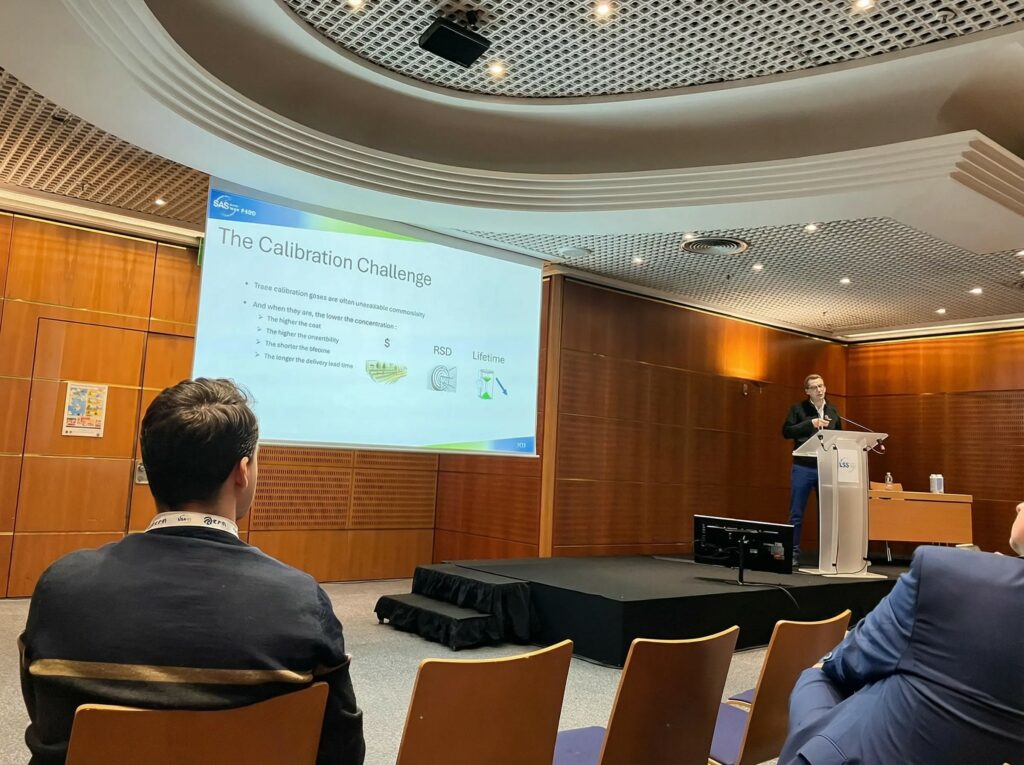
The calibration challenge at trace levels
Trace-level calibration gases are often simply not available commercially. And when they are, everything gets worse as the concentration drops:
- Higher cost per cylinder.
- Higher relative uncertainty on the certified value.
- Shorter shelf life, as reactive species degrade in the cylinder.
- Longer delivery lead times.
The result is a practical bottleneck: your analyser is more sensitive than the reference you are calibrating it against.
The solution: dynamic gas dilution under ISO 6145-7
Dynamic gas generation tackles this by producing the standard on site, at the moment of use, from a higher-concentration certified source:
- On-site generation of trace calibration gases, flexible and immediately available.
- Full traceability, following an international standard.
- Standardised method: the ISO 6145 family, specifically the ISO 6145-7 dynamic-dilution method.
Technically, GasMix systems use high-accuracy mass flow controllers with a combined uncertainty below ±1 % of set flow, can reach a dilution factor of 108 with a second dilution stage (from 100 % down to approximately 10 ppb), automate the whole generation sequence, and are built for aggressive gases and trace work with SS316 tubing, inert coating and zero-dead-volume fittings. Choosing the right flow range for each channel is part of getting this right, see how to choose the right MFC range.
Generate your trace-level standard on demand
Tell us your target compounds, matrix and concentration range, and we will confirm the configuration and the expected uncertainty for your application.
Request a quote Start the Product FinderDesigning for trace analysis: why materials matter
At ppb levels, adsorption and memory effects are no longer negligible. Every part in contact with the gas, from the diluter to the piping, has to be designed for trace work, because a reactive molecule that sticks to a wall never reaches the analyser. Inert coating of the flow path is the single most important design choice.
Ammonia is the textbook case, a notoriously sticky gas. Published work on ammonia adsorption on treated stainless-steel and polymer surfaces shows just how large the effect is, and how much an inert-coated surface reduces it. The practical consequence: without a trace-designed flow path, a ppb ammonia standard is lost between the mixer and the detector.
Traceability, metrology and the uncertainty budget
A number you cannot defend is not a result. The GasMix approach documents the full chain:
- NIST-traceable MFC calibration: the volumetric flowmeters used to calibrate the mass flow controllers are certified by an accredited ISO 17025 laboratory.
- Complete audit trail: mixture-generation certificates report the generated concentrations and their associated uncertainties.
- GUM uncertainty budget: the main contributions, initial gas-standard uncertainty, MFC calibration-flowmeter uncertainty and MFC uncertainty, are each expressed as a standard uncertainty and combined per the GUM.
Two figures matter and they are not the same thing. The MFC combined uncertainty is below ±1 % of set flow, that is the instrument-level performance. The expanded uncertainty on the final concentration is U = k × uc with a coverage factor k = 2 (about 95 % confidence), and with certified standards and calibrated MFCs, expanded uncertainties below 2 % are routinely achievable.
Dynamic dilution vs. trace-level cylinders
| Criterion | Trace-level certified cylinders | Dynamic dilution (GasMix) |
|---|---|---|
| Availability | Often not available commercially | Generated on site, on demand |
| Concentration range | Fixed at order time | 100 % to ~10 ppb, adjustable any time |
| Uncertainty at low concentration | Rises as concentration falls | < 2 % expanded (k=2), documented |
| Shelf life | Short, reactive species degrade | Generated fresh, no degradation |
| Lead time | Long delivery lead times | Immediate |
| Reactive / sticky gases (NH3, H2S) | Difficult to certify and keep stable | Inert-coated path, generated at point of use |
| Traceability | Supplier certificate | NIST-traceable, audit trail, per-mixture certificate |
| Number of levels | One per cylinder | Full multi-point sequence, automated |
What the method actually delivers
The following results were obtained on GasMix dynamic-dilution systems (AIOLOS platform) and reflect real measurements, including the harder cases, not just the easy ones.
Hydrogen purity (ISO 14687)
Generating the compounds listed in ISO 14687 (Ar, O2, N2, CO, CH4, CO2) allows both calibration and assessment of detection limits, with excellent linearity across the range. See the dedicated hydrogen fuel purity calibration (ISO 14687) application.
Sulfur compounds, sub-ppm to low-ppb
From a starting standard of several sulfur compounds at around 1 ppm mol in a hydrogen matrix, diluted dynamically:
| Compound | RSD at ~100 ppb (n=3) | RSD at ~1 ppb (n=3) |
|---|---|---|
| H2S | 1.9 % | 7.9 % |
| COS | 0.8 % | 0.5 % |
| MeSH | 0.3 % | 13.8 % |
| EtSH | 0.6 % | 5.9 % |
| DMS | 1.0 % | 3.3 % |
At 100 ppb the repeatability is excellent for all five compounds (RSD 0.3 to 1.9 %). At the far more demanding 1 ppb level, all five are still measurable: the most stable compounds (COS, DMS, EtSH) stay within a few percent, while the most reactive (H2S, MeSH) show the higher RSD you would expect at the very bottom of the range. This is the honest picture of where the boundary lies, and it is far below what a certified cylinder can practically deliver.
Ammonia at trace levels
Ammonia is the hard test, extremely adsorptive. From a 10 ppm mol NH3-in-H2 standard, with the sampling line purged for 6 minutes at 200 ppb and a 2-minute stabilisation:
| Level | RSD (n=30) | Assessment |
|---|---|---|
| 100 ppb NH3 | 7.1 % | Stable and repeatable |
| 50 ppb NH3 | 19.4 % | Controlled performance near the practical limit |
Even for a gas this sticky, dynamic dilution delivers stable, repeatable measurement at 100 ppb and controlled performance down to 50 ppb, which is exactly the range where cylinders struggle most with adsorption and drift.
PFAS compounds
Dynamic dilution has also been applied to the calibration of fluorinated (PFAS) compounds at trace levels, generating a range of concentrations from a higher-concentration standard with good linearity, an increasingly important capability as PFAS monitoring requirements expand.
Which GasMix system for trace-level work
The right instrument depends on how many gases you blend and how deep you need to dilute. For compact two-gas dilution, ZEPHYR II; for automated multi-gas dilution and multi-point sequences, AIOLOS III; for complex mixtures up to 16+ channels, HURRICANE; and for VOC and BTEX standards generated from a liquid, NEPHOS. Not sure which fits? Choosing the right gas mixer walks through it, or the Product Finder recommends a configuration from your answers.
Frequently asked questions
What is dynamic gas dilution, and how does it reach ppb levels?
Dynamic dilution generates a concentration in real time by precisely metering a certified source gas against a dilution gas with mass flow controllers. A single dilution stage covers a wide range; a second (cascade) stage extends it to a dilution factor of up to 108, taking a 100 % source down to approximately 10 ppb. It is standardised under ISO 6145-7.
How accurate is a trace-level standard made this way?
Two levels apply. The mass flow controllers have a combined uncertainty below ±1 % of set flow. On the final concentration, with certified standards and calibrated MFCs, an expanded uncertainty (k = 2, ~95 % confidence) below 2 % is routinely achievable, and it is reported per mixture with a full audit trail.
Why not just buy trace-level certified cylinders?
At trace levels they are often unavailable, and when available they cost more, carry higher uncertainty, have shorter shelf life and longer lead times, and each fixes a single concentration. Dynamic dilution generates any concentration on demand from a more stable higher-concentration source, with documented traceability.
How is adsorption of sticky gases like ammonia handled?
By designing the whole flow path for trace analysis: SS316 tubing with an inert coating and zero-dead-volume fittings, so reactive molecules are not lost to the walls between the diluter and the analyser. In testing, ammonia gave a 7.1 % RSD over 30 runs at 100 ppb and controlled performance down to 50 ppb, after a short line purge and stabilisation.
Is the method traceable and standards-compliant?
Yes. Generation follows ISO 6145-7; the MFC calibration is NIST-traceable via volumetric flowmeters certified by an accredited ISO 17025 lab; and each mixture comes with a certificate reporting the generated concentration and its uncertainty, computed with the GUM framework.
Which compounds has this been demonstrated on?
Published and in-house results cover hydrogen-purity compounds under ISO 14687 (Ar, O2, N2, CO, CH4, CO2), sulfur species (H2S, COS, MeSH, EtSH, DMS) from ~100 ppb down to ~1 ppb, ammonia at 50–100 ppb, and PFAS compounds at trace levels.
Bring trace-level calibration in-house
25+ years specifying gas dilution and generation systems. Tell us your compounds and target levels, and we will spec the right GasMix system, or start with the Product Finder.
Request a quote Start the Product FinderOr email gasmix@alytech.fr.
Method: ISO 6145-7 dynamic dilution; uncertainty per the GUM (k = 2). MFC calibration NIST-traceable via ISO 17025-accredited laboratories. Ammonia adsorption reference: O. Vaittinen et al., adsorption of gas-phase ammonia on treated stainless-steel and polymer surfaces. AlyTech, GasMix.