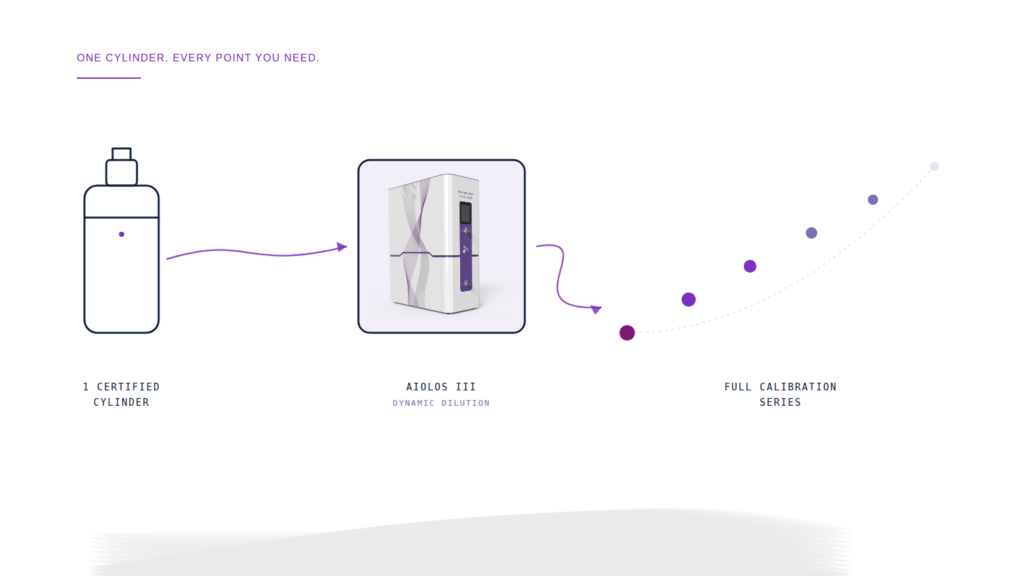
You need a gas mixer or gas diluter when a single certified cylinder cannot cover your whole analytical range. This is happening more and more often: methods keep moving toward lower concentrations, and one certified point rarely matches the sample you actually measure. A dynamic dilution system lets you keep one concentrated certified cylinder and generate every calibration point you need from it, on demand.
Certified cylinders stay at the heart of this approach. The gas mixer does not replace them. It multiplies what each cylinder can do.
What does a certified cylinder give you, and where does it stop?
A certified gas cylinder gives you one concentration at a documented uncertainty. It is an excellent traceable reference, and it will fulfil part of the request: the high end of the range, in most cases.
It stops there. A single fixed point cannot cover the entire range of interest, approach an unknown sample concentration, or bracket that concentration between two known points. As soon as your method requires several concentrations, the question is no longer whether the cylinder is good, but how to turn one good cylinder into the full series of standards you need.
When is a one-point calibration sufficient?
One-point calibration is a fair way of working for process monitoring. The goal is to follow a trend and detect a sudden change in process parameters, so a single calibration point close to the expected concentration can be good enough.
Even here, a gas diluter brings a strong advantage. You keep one concentrated cylinder, which is trustable, economical, and has a long validity time, and you prepare the working concentration through a dedicated, targeted dilution. When the process point moves, you adjust the dilution instead of ordering a new cylinder. One cylinder, many standards.
Why run a multipoint calibration?
For accurate quantitative analysis, multipoint calibration is best practice and often a formal requirement. The advantages are not questionable:
Linearity check across the working range. Determination of the Limit of Detection (LOD) and Limit of Quantification (LOQ) of the method. Blank value evaluation. The ability to bracket the unknown sample concentration between calibration points.
Two parameters must be considered together: the concentration range itself, and the dynamic response of the analyzer involved. Analyzers with several measurement ranges need each range calibrated with its own set of points, not just one endpoint. Dynamic dilution is almost always the only practical way to generate this complete series of concentrations from one certified standard.
How does dynamic dilution work?
Dynamic dilution blends a controlled flow of a certified gas standard with a controlled flow of diluent gas, using mass flow controllers, to produce a new concentration in real time. The output concentration follows directly from the flow ratio, so any point within the dilution range can be generated on demand and modified in seconds.
This is a recognized reference method: ISO 6145-7 describes the preparation of calibration gas mixtures by dynamic dilution using thermal mass flow controllers. AlyTech instruments operate according to this method, with a signed manufacturer’s declaration of compliance available, and an optional COFRAC accredited ISO 17025 flow rate verification for laboratories that need accredited traceability of the flow measurements.
What does this change in practice?
| Your need | Certified cylinder alone | Cylinder + dynamic dilution |
|---|---|---|
| Single-point check near a known concentration | Works if the certified point matches your target | Any target point prepared from one concentrated cylinder |
| Multipoint calibration curve | One cylinder per point | Full curve from one cylinder, run as an automated sequence |
| LOD / LOQ determination | Rarely practical at low levels | Low-level points generated by dilution of a stable concentrated standard |
| Bracketing an unknown sample | Not possible with one fixed point | Points placed above and below the sample on demand |
| Target concentration changes | New cylinder order and delivery time | New setpoint in the software |
| Cylinder logistics | Multiple cylinders to buy, store, and track | Fewer cylinders to store, longer validity of concentrated standards |
Which instrument fits which situation?
For diluting one certified standard across a wide concentration range, a smart gas diluter such as ZEPHYR II covers the need. For mixing several components, or generating ppm and percent level standards at constant total flow, a multi-channel gas mixer and diluter such as AIOLOS III is the right architecture. In both cases the certified cylinder remains the traceable reference, and the instrument generates the working standards from it.
FAQ
Does a gas mixer replace certified cylinders?
+
No. The certified cylinder remains your traceable reference. The gas mixer or diluter extends it, generating all intermediate concentrations from that single reference.
Is dynamic dilution a recognized calibration method?
+
Yes. ISO 6145-7 is the reference method for preparing calibration gas mixtures by dynamic dilution with thermal mass flow controllers. AlyTech provides a manufacturer’s declaration of compliance with this method, and an optional COFRAC accredited ISO 17025 flow rate verification certificate.
When is a one-point calibration acceptable?
+
Mainly in process monitoring, where the goal is to follow a trend and detect sudden changes, and where the calibration point sits close to the expected concentration. For quantitative work, linearity checks, LOD and LOQ, a multipoint calibration is needed.
Can I calibrate an analyzer that has several measurement ranges?
+
Yes, and each measurement range needs its own set of calibration points. Dynamic dilution makes it practical to sweep every range from the same certified standard.
Why keep a concentrated cylinder rather than several low-level ones?
+
Concentrated standards are more stable, have a longer validity time, and cost less per calibration point. Low-level working standards are then prepared fresh by dilution, exactly when needed.
Not sure if your application needs one?
Every application is different: cylinder concentrations, analyzer ranges, flow and pressure requirements all change the answer. Describe your setup in a few lines and our team will tell you honestly whether dynamic dilution fits your case, and which configuration makes sense.
Describe your application →