NEPHOS: Generating Traceable VOC and BTEX Gas Standards from a Liquid
How a liquid-to-gas mixer is transforming the calibration of volatile organic compound analysers
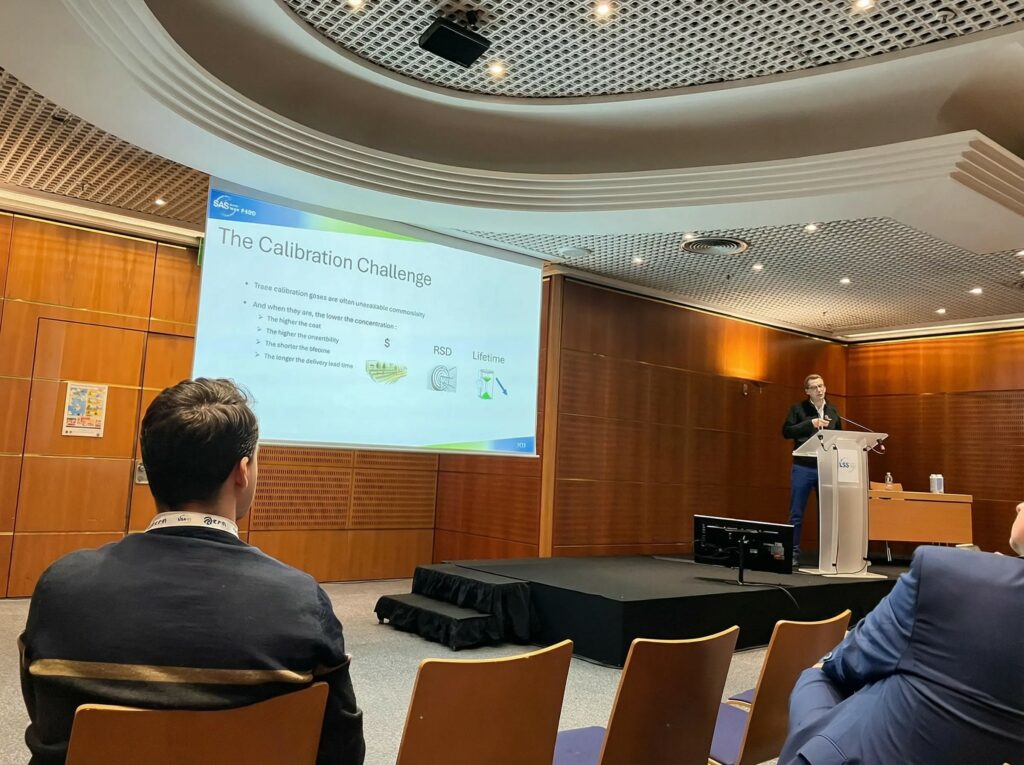
1. The VOC and BTEX Calibration Challenge
Volatile organic compounds (VOCs), and in particular the BTEX group (benzene, toluene, ethylbenzene and xylenes), are among the most closely monitored air pollutants worldwide. Present in industrial emissions, fuel vapours and indoor environments, BTEX compounds carry well-documented toxicological and carcinogenic risks. Benzene is classified as a Group 1 human carcinogen by the IARC, linked to leukaemia at chronic low-level exposure, while ethylbenzene is a possible carcinogen (Group 2B) and the xylene isomers exert neurological and systemic effects. Regulatory agencies have set strict exposure limits: the US EPA limits benzene in drinking water to 5 ppb, and OSHA caps occupational benzene exposure at 1 ppm in workplace air.
Accurate measurement of BTEX in ambient, industrial and indoor air is therefore a regulatory and scientific obligation across sectors ranging from oil refining and petrochemicals to environmental monitoring, portable sensor manufacturing and occupational health. The analytical techniques used most frequently include GC-FID (typically low ppb to ppm range), GC-PID and GC-MS coupled with thermal desorption, which can reach sub-ppb sensitivity. However, the quality of any measurement is only as good as the calibration standards used.
Certified BTEX gas standards in pressurised cylinders are genuinely difficult to produce, store and use reliably. Research published in Elementa: Science of the Anthropocene has shown that VOC concentrations in gas cylinders drift as cylinder pressure decreases, due to adsorption onto internal walls, reactive loss and fractionation, even in specially treated cylinders. Combined with high purchase costs, long lead times and limited shelf life, this makes traditional cylinder-based calibration a persistent bottleneck in analytical laboratories. The NEPHOS liquid-to-gas standard generator from AlyTech was designed specifically to address this problem.
2. NEPHOS: From Liquid to Gas, with Metrological Precision
NEPHOS is AlyTech’s latest evolution of the LiqMix platform, a bench-top instrument that generates precise, traceable gas-phase calibration standards on demand, on site, starting from a liquid source. Rather than purchasing and managing a library of certified gas cylinders at fixed concentrations, the user works from a single liquid standard (a pure compound or a commercially available liquid mixture such as a BTEX solution) and lets NEPHOS handle the rest.
2.1 Operating Principle
The operating principle combines two precision flow technologies: a Coriolis-type liquid mass flow meter, which measures and controls the liquid feed rate with high accuracy independently of temperature, pressure, viscosity or density variations; and thermal mass flow controllers (MFCs) for each gas channel, factory-calibrated using NIST-traceable procedures across the full dynamic range for the relevant gas matrix.
The liquid is stored in a pressurised inert canister. Helium is recommended as the pressurisation gas to prevent bubble formation in the feed line. It is injected at a precisely controlled flow rate into a heated vaporisation chamber, where it nebulises and vaporises into the carrier gas stream. Heated internal and external transfer lines prevent any cold spot downstream of the vaporiser, ensuring a clean, stable, single-phase gas output at the delivery point. The resulting concentration can be further reduced through optional two-stage cascade dilution, extending the working range from percent levels all the way down to ppb, with a dilution factor of up to 10^8 in a single instrument.
2.2 Technical Specifications
| Parameter | Value |
|---|---|
| Liquid channels | 1 or 2 simultaneously |
| Liquid flow range (Coriolis) | 0.5–5 g/h or 0.5–200 g/h |
| Gas channels | 1 to 6 |
| Gas supply pressure | 3–8 bar(g) |
| Maximum dilution factor | Up to 10^8 |
| Output concentration accuracy | < % |
| Output flow accuracy | < 2 % of measured flow |
| Max vaporiser temperature | 200 °C |
| Max external line temperature | 200 °C |
| Traceability | NIST-traceable, automatic uncertainty calculation, Audit Trail |
2.3 LiqMix Software and Automation
NEPHOS is controlled by the LiqMix / AlySoft software, which covers sequence programming (user-defined concentration levels, hold times and transitions), real-time monitoring of flows and temperatures, automatic uncertainty calculation for each generated mixture, and synchronisation with third-party analysers via digital I/O triggers. The software produces certified reports in PDF, CSV or JSON format, with an Audit Trail for full QA/QC documentation. For multi-point calibrations, a complete sequence of concentration levels can be generated and injected automatically into a connected GC, with no manual intervention required.
3. Application to VOC and BTEX Analyser Calibration
3.1 Hydrocarbon Multipoint GC-FID Calibration
The data presented below were obtained with the LiqMix Cascade, the predecessor instrument to NEPHOS, which shares the same liquid vaporisation and dynamic dilution principle. The study was conducted in collaboration with Axel’One, an industrial chemistry and environmental R&D platform based in Lyon, France.
The objective was to calibrate a GC-FID analyser using a liquid hydrocarbon mixture composed of equal volumes of hexane, octane and decane. These three compounds span a range of boiling points (69 to 174 °C) representative of a wide volatility window, which makes them useful model compounds for demonstrating multipoint generation performance.
Temperature settings for vaporisation:
| Component | Set point |
|---|---|
| Vaporiser | 60 °C |
| Mixing chamber | 60 °C |
| Heated transfer lines | 60 °C |
Six concentration levels generated automatically in one sequence:
| Compound | Concentration levels (ppm mol) |
|---|---|
| Hexane | 10 – 20 – 40 – 60 – 80 – 100 |
| Octane | 8 – 16 – 32 – 48 – 64 – 79 |
| Decane | 7 – 14 – 27 – 41 – 55 – 68 |
The GC-FID used was an Agilent 7890B fitted with a DB-1 column (530 µm x 10 m, 2.65 µm film), operated in splitless mode. Each concentration level was held for approximately one hour, with transitions managed automatically by the software.
GC-FID calibration results:
| Compound | R² | Max RSD (%) | Validated range |
|---|---|---|---|
| Hexane | 1.000 | 2.2 % | 10–100 ppm mol |
| Octane | 0.9997 | 2.1 % | 8–79 ppm mol |
| Decane | 0.9995 | 2.1 % | 7–68 ppm mol |
Linearity was excellent for all three compounds across the full range, with RSDs below 2.5 % at every concentration level including the lowest points. The relative generation uncertainty, calculated automatically by the software, was ±3.5 % for all mixtures under these conditions. This figure is consistent with the requirements of standardised VOC analytical methods and confirms the suitability of the liquid vaporisation approach for multipoint GC calibration.
3.2 Real-World BTEX Applications
The LiqMix / NEPHOS platform is deployed across a range of industrial BTEX and VOC applications. A petroleum research centre uses NEPHOS to prepare BTEX gas standards from liquid for the calibration of a GC-FID, removing the need to stock multiple certified BTEX cylinders at different concentrations. A petroleum R&D centre generates BTX gas standards at multiple concentrations for GC calibration from a single liquid solution. An oil and gas company prepares BTEX gas atmospheres for reactor testing in both batch and continuous operation modes. A gas analyser manufacturer generates standards for testing portable emission monitoring sensors, with the additional capability of controlling the humidity of the generated gas, something that standard gas cylinders cannot provide.
4. Scientific Validation: MethodsX Publication (2025)
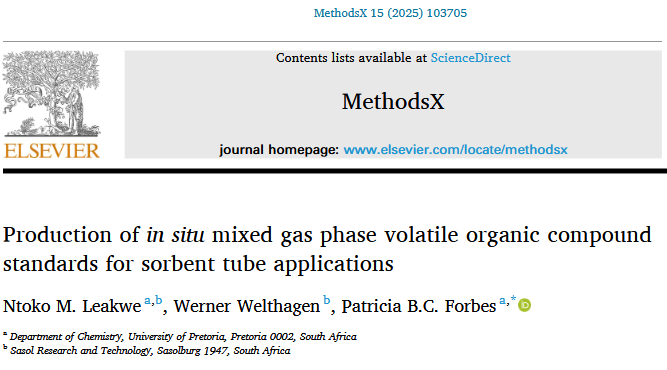
Independent scientific validation of the liquid-to-gas generation approach for BTEX calibration was published in MethodsX (Elsevier, 2025): “Production of in situ mixed gas phase volatile organic compound standards for sorbent tube applications” by Leakwe N.M. et al. The study used the LiqMix Cascade, NEPHOS’s predecessor, which shares the same liquid vaporisation and dynamic dilution principle.
4.1 Context and Objectives
Quantifying VOCs collected onto sorbent tubes requires gas-phase standards at precisely controlled concentrations. At the ng-to-µg scale typical of sorbent tube loadings, any error in standard preparation propagates directly into the analytical result. The study validated a method for on-site preparation of BTEX gas standards using liquid-phase evaporation and dynamic dilution with nitrogen, via an AlyTech LiqMix Cascade instrument.
4.2 Experimental Setup
BTEX gas standards were generated by vaporising a liquid BTEX reference solution and diluting dynamically with nitrogen. The gas flow was set at 60 mL/min, chosen to match the conditions of passive VOC diffusive sampling. The generated gas was used in two configurations: active sampling, with BTEX vapours collected onto Carbograph 4 sorbent tubes at loadings of the order of micrograms per tube; and passive sampling, with BTEX vapours collected onto Radiello passive sampling cartridges at loadings of the order of nanograms per cartridge. Analysis was carried out by thermal desorption GC-MS using a Shimadzu TD20 system (desorption at 150 mL/min onto a Tenax cold trap, then ballistic re-desorption at 50 °C/min to 310 °C, split ratio 100:1).
4.3 Results
Key result: A 99 % recovery against a certified BTEX reference material confirms that the concentration of standards generated by the liquid-to-gas method is indistinguishable, within measurement uncertainty, from the nominal CRM value. The authors concluded that the method provides a reliable, practical and cost-effective alternative to conventional cylinder-based calibration for sorbent tube VOC analysis, with the flexibility to generate standards at exactly the concentrations required for each application.
5. NEPHOS vs. Certified Gas Cylinders
| Criterion | Certified gas cylinders | NEPHOS (LiqMix) |
|---|---|---|
| Cost | High (purchase, logistics, disposal) | Low (single liquid, multiple concentrations) |
| Lead time | Several weeks | Immediate, on-site generation |
| Shelf life | Limited: BTEX degrades in cylinders | Unlimited (stable liquid source) |
| Number of concentrations | Fixed at order time | Unlimited, adjustable at any time |
| Reactive or unstable compounds | Difficult to certify and store | Generated fresh on demand |
| Concentration accuracy | Certified at manufacture | < 1 %, with automatic uncertainty |
| Traceability | Supplier certificate | NIST-traceable, Audit Trail, reports |
| Humidity control | Not possible | Yes, via second liquid channel (water) |
| Analyser synchronisation | Manual | Automated via digital I/O |
| Footprint | Cylinder storage required | Single bench-top unit |
6. Industry Context and Regulatory Drivers
Environmental monitoring
Ambient air quality monitoring networks, fence-line monitoring and stack emission testing all require periodic calibration of VOC analysers with traceable standards. Standards such as EN 14181 define quality assurance procedures for automated measuring systems, with multi-point linearity verification as a core requirement.
Occupational health
Personal exposure assessments using sorbent tubes and GC-MS require calibration standards matched to the expected exposure concentration range, not a fixed set of concentrations determined by a gas supplier’s standard catalogue.
Sensor and analyser validation
Manufacturers of portable BTEX sensors and photoionisation detectors require flexible, programmable calibration gas sources to characterise instruments across a wide dynamic range during R&D, manufacturing QC and field validation.
Research and method development
Research groups developing new analytical methods for BTEX need the ability to generate standards at arbitrary concentrations, in various matrices and with controlled humidity, requirements that NEPHOS covers natively.
Conclusion
The NEPHOS liquid-to-gas standard generator provides a technically rigorous and practically effective answer to a well-known problem in analytical chemistry: the reliable, traceable and cost-effective calibration of VOC and BTEX analysers across a wide concentration range.
By vaporising a single liquid BTEX reference solution, NEPHOS generates an unlimited number of gas standards at user-defined concentrations, from percent down to ppb, with metrological traceability, automatic uncertainty calculation and full compliance with ISO 6145-7. The approach removes the instability, logistical burden and concentration constraints of certified gas cylinders.
The peer-reviewed study by Leakwe et al. in MethodsX (2025) provides independent evidence that BTEX gas standards generated by this liquid-to-gas approach achieve 99 % recovery against certified reference materials, covering the full analytical chain from standard generation through to sorbent tube loading and thermal desorption GC-MS analysis. For laboratories, analyser manufacturers and environmental monitoring operators looking to modernise their calibration workflows, NEPHOS is a concrete and well-documented option.
More information: gasmix.com/products/nephos | gasmix@alytech.fr
References
[1] Health risk assessment of BTEX compounds in indoor air (PMC/NIH).
[2] Risk assessment of BTEX in atmospheric air around the world (ScienceDirect).
[3] BTEX health and regulatory fact sheet (Pennsylvania Dept. of Health).
[4] GC-PID and thermal desorption methods for sub-ppb BTEX (ScienceDirect).
[5] Thermal desorption GC-MS for BTEX in ambient air (PMC/NIH).
[6] Stability of VOCs in gas cylinders with different internal wall treatments (Elementa).
[7] NEPHOS product page (GasMix).
[8] ISO 6145-7:2018, Preparation of calibration gas mixtures using dynamic methods.
[9] Leakwe N.M. et al., Production of in situ mixed gas phase VOC standards for sorbent tube applications, MethodsX 15 (2025) 103705.