Moving Toward Trustable Trace-Level Gas Quantification
As regulatory limits push deeper into the sub-ppm and ppb range, reliable calibration has become the real challenge. Here’s how dynamic gas dilution is solving the trace-level quantification gap.
Industries from hydrogen fuel to semiconductor manufacturing are facing a shared dilemma: the acceptable concentration limits for critical contaminants keep dropping, but the tools to reliably measure and calibrate at these extreme levels have not kept pace. Analyzers can now detect astonishingly low concentrations — the question is whether we can actually trust those measurements.
Why Trace-Level Gas Quantification Is Now Critical
Across multiple sectors, the maximum allowable impurity levels have reached sub-ppm and even low-ppb territory. This shift is driven by increasingly stringent safety, environmental, and quality standards.
In hydrogen fuel cell applications, ISO 14687 sets maximum impurity limits that directly protect fuel cell catalyst integrity. Compounds like carbon monoxide (CO), ammonia (NH₃), hydrogen sulfide (H₂S), and formic acid (HCOOH) must remain at sub-ppm or ppb concentrations — because even trace amounts can cause irreversible catalyst poisoning and system degradation.
In environmental monitoring, ambient air quality regulations often require detection of NO₂ and SO₂ below 50 ppb, which means calibration gases must be generated at even lower concentrations to build reliable calibration curves.
In semiconductor manufacturing, contaminants such as HF, NH₃, and siloxanes must be controlled below 10 ppb to prevent wafer damage and yield loss — making precise, traceable calibration an operational necessity.
The common thread is clear: as acceptable limits decrease, the demand for reliable and traceable quantification increases exponentially.
The Calibration Gas Challenge at Trace Levels
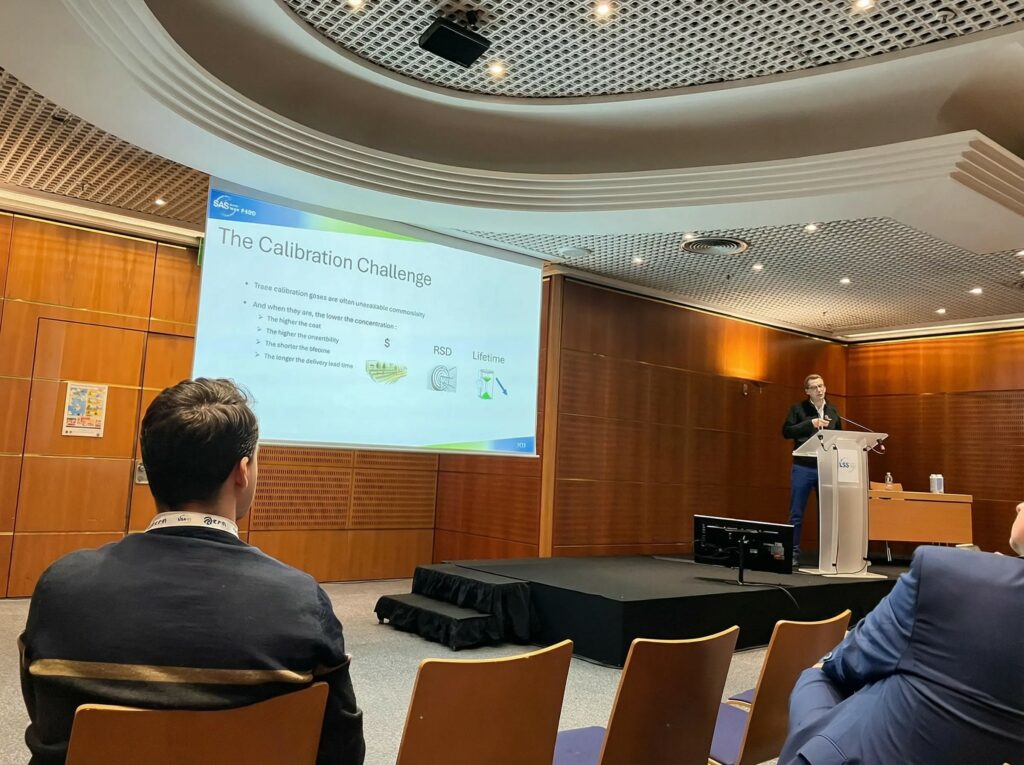
Obtaining calibration gases at the required trace concentrations is far from straightforward. In many cases, commercial trace-level calibration gas standards are simply not available. When they are, laboratories face a compounding set of problems: the lower the target concentration, the higher the cost, the greater the measurement uncertainty, the shorter the cylinder shelf life, and the longer the delivery lead times.
This creates a practical bottleneck. Even if an analyzer has the sensitivity to detect a few ppb of a target compound, the calibration reference used to verify that measurement may carry an uncertainty so large that the result becomes meaningless from a regulatory or quality assurance standpoint.
Dynamic Gas Dilution: A Proven Solution via ISO 6145-7
One effective approach to overcoming these challenges is dynamic gas generation following the ISO 6145-7 standard. Rather than relying on pre-mixed cylinders, dynamic dilution systems generate trace-level calibration gases on demand, directly at the point of use.
This method offers several key advantages. Calibration gases are generated on-site, eliminating supply chain delays and shelf-life concerns. The process is fully automated and provides immediate flexibility to produce any concentration within the system’s dilution range. Traceability is maintained through the calibration chain of the mass flow controllers (MFCs), and every generated concentration is documented with its associated uncertainty.
Using high-accuracy MFCs with combined uncertainty below ±1% of the set flow, modern dynamic dilution systems can achieve dilution ratios up to 10⁸ with a second-stage cascade — meaning a starting concentration of 100% can be diluted to approximately 10 ppb with full metrological traceability.
Designing for Trace Analysis: Why Materials Matter
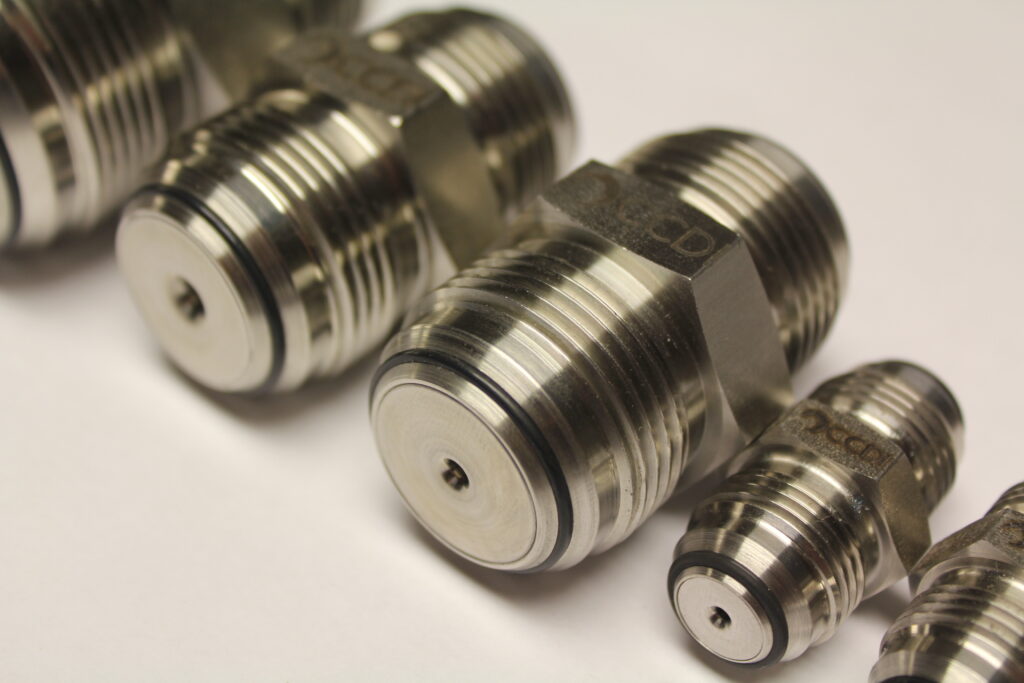
At the ppb level, gas adsorption and memory effects become significant sources of error. The entire gas path — from cylinder to analyzer — must be engineered specifically for trace analysis. This means using SS316L tubing with inert coatings (such as SilcoNert 2000) and zero-dead-volume fittings throughout the dilution system and sampling lines.
The impact of surface treatment is dramatic. Published research on ammonia adsorption shows that uncoated SS316L surfaces adsorb roughly 138 × 10¹² molecules/cm², while SilcoNert 2000 coated surfaces reduce this to just 5.7 × 10¹² molecules/cm² — a reduction of more than 95%. For highly adsorptive gases like NH₃, this level of surface inertness is essential to delivering stable and accurate concentrations at trace levels.
Metrological Traceability and Uncertainty Budgets
Trustable quantification requires more than just generating low concentrations — it requires knowing how accurate those concentrations are. Dynamic dilution systems provide this through a rigorous uncertainty framework aligned with the GUM (Guide to the Expression of Uncertainty in Measurement).
The main uncertainty contributions for a dynamically generated concentration include the initial gas standard uncertainty, the MFC calibration flowmeter uncertainty, and the MFC repeatability or standard deviation. Each contribution is expressed as a standard uncertainty (uᵢ), and the combined standard uncertainty (u_c) is calculated as the root sum of squares of all individual components.
The expanded uncertainty (U = k × u_c) is then reported at a 95% confidence level using a coverage factor of k = 2. In practice, when using a high-purity certified gas standard and properly calibrated MFCs, expanded uncertainties below 2% are routinely achievable, and can remain below 5% even in less favorable scenarios.
NIST-traceable calibration of mass flow controllers — certified through accredited ISO 17025 laboratories — ensures that every step of the dilution chain is documented and auditable.
Real-World Application Results
Hydrogen Purity Testing (ISO 14687)
Dynamic dilution has been successfully applied to calibrate gas chromatography systems for hydrogen purity analysis. Calibration curves for argon, oxygen, nitrogen, carbon monoxide, methane, and carbon dioxide all demonstrated excellent linearity with R² values above 0.999 across the concentration range required by ISO 14687 Grade D specifications. Detection limits achieved were below 0.1 µmol/mol for argon, oxygen, and nitrogen, and below 1 µmol/mol for methane, carbon dioxide, and heavy hydrocarbons.
Sulfur Compound Analysis at Sub-ppm and Low-ppb Levels
For sulfur species critical to hydrogen purity and natural gas quality, dynamic dilution from approximately 1 ppm starting concentrations produced highly reproducible results. At the 100 ppb level, relative standard deviations (RSD) ranged from 0.3% for methyl mercaptan (MeSH) to 1.9% for hydrogen sulfide (H₂S). Even at the extreme 1 ppb level, all five sulfur compounds — H₂S, COS, MeSH, EtSH, and DMS — remained detectable and quantifiable, with COS showing just 0.5% RSD.
Ammonia at Trace Levels
Ammonia is one of the most challenging gases for trace-level work due to its extreme adsorptivity. Despite this, dynamic dilution with proper surface treatment delivered stable and repeatable measurements at 100 ppb (RSD of 7.1% over 30 runs) and controlled performance down to 50 ppb. The methodology involved purging the sampling line at 200 ppb NH₃ for six minutes followed by a two-minute stabilization period — a practical protocol that ensures reliable results even for the stickiest compounds.
PFAS Compound Calibration
Dynamic dilution has also been applied to the emerging challenge of per- and polyfluoroalkyl substances (PFAS) in gas phase. Using certified standard mixtures containing 14 fluorinated compounds at nominal 1 ppm concentrations in nitrogen, calibration sequences from 20 ppb to 500 ppb were generated with excellent linearity, demonstrating that dynamic dilution is a viable approach for this rapidly growing analytical need.
Conclusion: Confidence Through Traceable Dynamic Calibration
As detection limits push into the low ppb range across critical industries, the question is no longer whether analyzers can measure that low — it’s whether we can trust those measurements. Dynamic gas dilution following ISO 6145-7, combined with NIST-traceable MFC calibration, inert gas paths, and rigorous uncertainty calculations, provides the metrological foundation needed to bridge the gap between analyzer capability and measurement confidence.
For laboratories and quality teams working in hydrogen purity, environmental monitoring, semiconductor fabrication, or PFAS analysis, dynamic calibration systems offer a practical path to reliable, flexible, and fully traceable quantification at the levels that matter most.
About AlyTech – The GasMix™ Company
AlyTech designs and manufactures precision gas mixing and calibration systems, including the AIOLOS III dynamic gas dilution platform. With ISO 6145-compliant technology and NIST-traceable calibration, AlyTech supports laboratories and industries worldwide in achieving trustable trace-level gas quantification.
This article is based on a presentation delivered at GAS Analysis 2026, Paris.
Related Topics: gas calibration, trace gas analysis, ISO 6145-7, dynamic gas dilution, hydrogen purity ISO 14687, sub-ppm calibration, ppb gas measurement, NIST traceable calibration, mass flow controller uncertainty, PFAS gas analysis, sulfur compound detection, ammonia trace measurement, GUM uncertainty calculation, gas mixer, calibration gas generation
Download the full presentation below :