
NIST Traceable Certified Value: What It Means and Why It Matters for Gas Calibration
If you work in gas analysis, environmental monitoring, or laboratory calibration, you have likely encountered the term NIST traceable certified value. But what does it actually mean — and why does it matter for the accuracy and legal defensibility of your measurements? This article explains metrological traceability, how it applies to the GasMix gas calibration system, and why it is a non-negotiable requirement in regulated industries.
What Is a NIST Traceable Certified Value?
A NIST traceable certified value is a measurement result that can be linked — through a documented, unbroken chain of calibrations — to a primary standard maintained by a National Metrology Institute (NMI) such as NIST (National Institute of Standards and Technology, USA).
According to the International Vocabulary of Metrology (VIM), metrological traceability is defined as:
“The property of a measurement result whereby the result can be related to a reference through a documented unbroken chain of calibrations, each contributing to the measurement uncertainty.”
In simple terms: every number on a calibration certificate must be provably connected — step by step — to the highest measurement authority in the world. Without this connection, a certified value is just a claim.
Why Is NIST Traceability Required in Gas Calibration?
In industries such as environmental monitoring, pharmaceutical manufacturing, semiconductor production, and industrial process control, measurement results must be not only accurate but legally and scientifically defensible. Regulatory frameworks including ISO/IEC 17025, EPA measurement standards, and industrial audit protocols all require documented metrological traceability.
Without a NIST traceable certified value, your gas calibration data may be:
- Rejected during regulatory inspections or audits
- Inadmissible in environmental compliance reporting
- Insufficient for ISO/IEC 17025 laboratory accreditation
- Unreliable as a reference for scientific publication
This is why traceability is built into the core architecture of the GasMix calibration system — not as an afterthought, but as a fundamental design requirement.
How GasMix Establishes NIST Traceable Certified Values
The GasMix system achieves metrological traceability through a three-level calibration hierarchy. Each level is calibrated against the level above it, with uncertainty rigorously controlled and documented at every stage.
Level 1: Calibration of Mass Flow Controllers (MFCs)
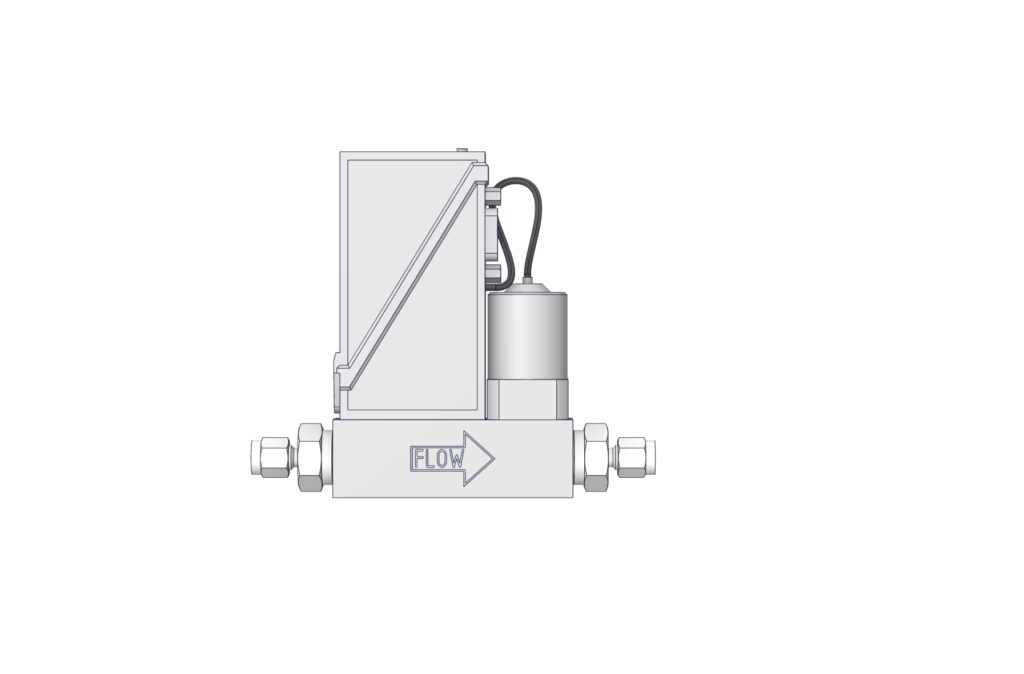
The accuracy of the GasMix system starts with the calibration of its internal Mass Flow Controllers (MFCs) — the core components that precisely control gas flow within the system. They are calibrated and adjusted using certified volumetric flowmeters whose accuracy has been independently verified. This is the first critical link in the GasMix traceability chain.
Level 2: Twice-Yearly Recertification of Reference Flowmeters
The certified flowmeters used to calibrate MFCs are returned to the factory twice per year for full recertification. This regular cycle is essential: without it, instrument drift, component aging, and environmental factors can silently degrade calibration accuracy over time. During recertification, flowmeters are verified against higher-level reference standards — one step closer to the national primary standard.
Level 3: Primary Standard at a National Metrology Institute (NMI)
At the top of the hierarchy sits a primary standard maintained by a recognized National Metrology Institute. These standards are established through fundamental physical principles and represent the highest level of measurement accuracy achievable. All reference standards in the GasMix calibration chain are ultimately traceable to one of the following NMIs:
- NIST — National Institute of Standards and Technology (USA)
- LNE — Laboratoire national de métrologie et d’essais (France)
- VSL — Van Swinden Laboratorium (Netherlands)
- PTB — Physikalisch-Technische Bundesanstalt (Germany)
- NPL — National Physical Laboratory (UK)
NIST Traceability vs. “NIST Equivalent” — What Is the Difference?
A common question in gas calibration is whether a certificate traceable to a European institute such as LNE or PTB is equivalent to a NIST traceable certified value. The answer is yes — and this equivalence is formally guaranteed.
Under the CIPM Mutual Recognition Arrangement (CIPM MRA), all participating NMIs conduct systematic international comparisons and publish their degrees of equivalence. A calibration certificate traceable to LNE, VSL, PTB, or NPL carries the same metrological weight as one traceable to NIST — and is accepted by international regulatory bodies worldwide.
Full Documentation: The Backbone of Metrological Traceability
A traceable calibration chain is only as strong as the documentation supporting it. GasMix maintains a comprehensive archive of all calibration records throughout the hierarchy, including:
- Calibration certificates for all internal MFCs
- Recertification records for reference flowmeters (renewed twice per year)
- Traceability certificates linking all reference standards to NMI primary standards
- Measurement uncertainty budgets at each calibration level
All documentation is available for consultation at any time, ensuring that any GasMix certified value can be fully audited — at any point in its operational life. This is essential for laboratories operating under ISO/IEC 17025 accreditation and for industries subject to regulatory inspection.
Frequently Asked Questions About NIST Traceable Certified Values
What does “traceable to NIST” mean on a calibration certificate?
It means the instrument has been calibrated through a documented chain of comparisons that ultimately links back to a primary standard maintained by NIST. Each link in the chain is supported by a calibration certificate that includes measurement uncertainty.
Is NIST traceability required for ISO/IEC 17025 accreditation?
Yes. ISO/IEC 17025 requires laboratories to use measurement equipment that is calibrated and traceable to national or international measurement standards. NIST traceability — or its equivalent from another recognized NMI — satisfies this requirement.
How often should a gas calibration system be recalibrated?
Recalibration frequency depends on the application, instrument stability, and regulatory requirements. GasMix recertifies its reference flowmeters twice per year as a minimum standard, and recommends that users follow their sector’s applicable calibration interval guidelines.
Can a certificate from a European NMI replace a NIST traceable certificate?
Yes. Under the CIPM MRA, certificates from recognized NMIs — including LNE, VSL, PTB, and NPL — are metrologically equivalent to NIST traceable certificates and are accepted by international regulatory bodies.
Conclusion: NIST Traceability Is a Technical Commitment, Not a Label
A NIST traceable certified value is far more than a phrase printed on a datasheet. It is a verifiable, documented guarantee that every measurement result delivered by the GasMix system can be traced — without a single break in the chain — to the highest metrological authority available.
For gas calibration applications where accuracy, reproducibility, and regulatory compliance are critical, this unbroken chain of traceability is not a feature. It is the standard.
Want to learn more about GasMix calibration documentation or request a traceability certificate? Contact our technical team.
Authors: Florian RENETEAU, Augustin RAMEL , Laurent COURTHAUDON, Klaudia LULKOWSKA